Dr. Esraa El Saeed Ammar: Desertification and climatic changes over the years

desertification does not mean the encroachment of the desert, although it can include the invasion of sand dunes of the land. Rather, it means the continuous degradation of dryland ecosystems as a result of Human activities and climate changes. It is also considered one of the most serious challenges against the development in our time, due to its severe impact on human welfare and the environment. Desertification is the process by which fertile land becomes desert, typically as a result of drought, deforestation, or unsuitable agriculture. The permanent decrease in biological productivity of dryland areas.
Drylands comprise 41% of the earth’s land area and are home to roughly 2 billion people (about 34% of the earth’s population). Currently, over 250 million people in more than 100 countries are directly affected by desertification and more are at risk. The situation is most severe in Africa, where 66% of the total land area is arid or semi-arid. Not only is desertification harmful to the earth and its inhabitants, but it is also expensive each year, the world loses US$42 billion to desertification and its effects.
The cases of desertification and the degree of its severity differ from one region to another, depending on the quality of the relationship between the natural environment on the one hand and humans. There are four cases of desertification according to the United Nations classification of desertification: 1. Mild desertification: very small damage to vegetation cover and soil. 2. Moderate desertification: moderate damage to vegetation cover and formation of small sand dunes.3. Severe desertification: the spread of unwanted weeds and shrubs in the pasture at the expense of desirable species. 4. Very severe desertification: a process of forming large amounts of bare and active sand dunes, in addition to the formation of many canyons and valleys, and exposure of the soil to salinization harmful to it. This type of desertification is one of the most dangerous cases, as it has a negative impact on the biological capacity of the environment. There are many manifestations or evidence of desertification: Soil erosion, movement back of fixed sand dune, the decrease in the area of vegetation cover, the decay of the soil quality and productivity, soil salinization and waterlogging, lowering of the irrigation water, increasing the dust amount in the air, biological evidence and socioeconomic evidence.
Desertification Causes: The two main causes of desertification are ‘climatic variations’ and ‘human activities.’ 1. Removal of natural vegetation cover due to over-harvesting of fuel wood. 2. Agricultural activities in vulnerable arid and semiarid ecosystems, which are thus stressed beyond their capacity. 3. Overgrazing is the leading cause of desertification around the world. 4. Urbanization, climate change, groundwater overdraft, deforestation, natural disasters, and agricultural tillage practices to ensure soils more vulnerable to wind.

Desertification globally
Desertification is a global problem that many countries around the world suffer from. It is defined as a decrease in the biological production capacity of the land or the deterioration of the fertility of the productive land to be similar to desert climatic conditions. Desertification leads to a decrease in the production of plant cover, and the total desertified areas in the world amounted to about 46 million square kilometers, of which about 13 million square kilometers belong to the Arab world, or about 28% of the total desertified areas in the world.According to IFAD’s experience with desertification; land degradation is often among the causes and consequences of rural poverty. Desertification can cause poverty, and poverty can cause further desertification.Desertification threatens the livelihoods of about one billion people in 100 countries.Desertification are seen in many parts of the world, but is predominantly in India, Australia, Asia and Africa. More than six million faddans of land in India are turned into a desert-like state annually.
The U.N. estimates about 30 million faddans of land across the globe are impacted by desertification every year.Desertification affects the rate of plant production for some crops, and this is reflected in the spread of drought in many areas, especially in the Arab world (Fig .1.).

Fig. 1.The world map of Biomes (natural vegetation regions of the world). Biomes are; 1. Arctic tudra and ice, 2. Boreal forest, 3. Temperate deciduous forest and subtropical evergreen forest, 4. Temperate grasslands, 5. Temperate rainforest, 6. Desert and semi desert, 7. Tropical deciduous forest and savanna, 8. Tropical rainforest and 9. Alpine tundra biomes.
Desertification in Africa
The most vulnerable region is a 3,000-mile stretch of land that includes 10 countries in the Sahel region of Africa. The Sahel is the area between the Saharan Desert and the Sudanian Savannah:
- (more than two million km2, or 1/5 of the total area), 2. Libya,
- Egypt, 4. Tunisia, 5. Morocco, 6. Mauritania, 7. Mali and 8. Sudan (Fig. 2.).
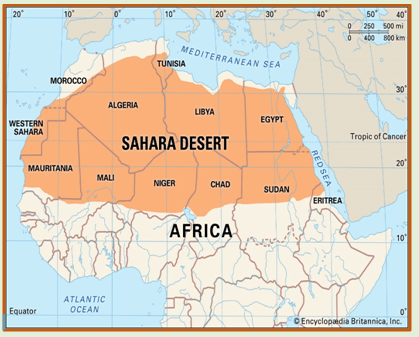
This region is under constant stress due to frequent droughts and soil erosion. A dense forest can become a field of dust in a matter of years, making mass migrations inevitable. Africans frequently migrate south in search of fertile land.Desertification affects about 46 % of Africa.Agriculture in Africa tends to result in low productivity:
- Most of the land is as a semi-desert.
- Clearing the land from trees reduces the structure of the soil.
- wind erosion the topsoil blows away and leaves a desert-like land.
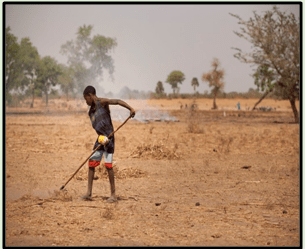
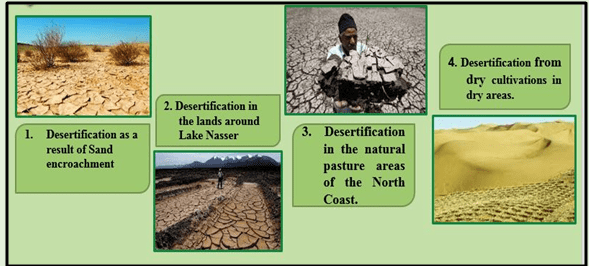
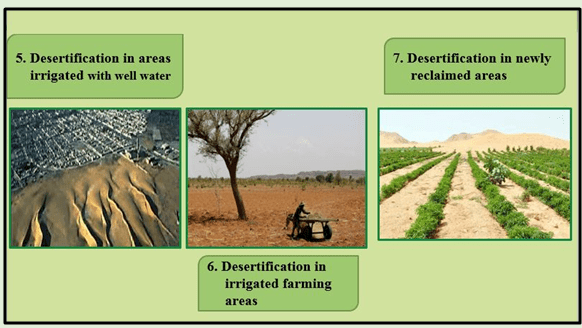
- Desertification in Egypt: Egypt has all cases of desertification.
Desertification in Sengal
The country that is arguably the most damaged by desertification is Senegal. Migrations in Senegal are common, as: wind erosion and climate changes destroy farms and livestock. Those most affected by desertification in Senegal move to Gabon, a country in West Africa, or even to Europe or South America.
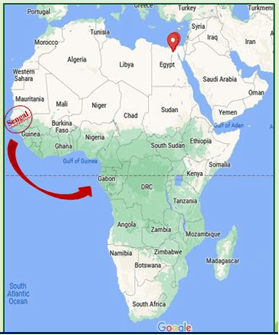
More than half of Senegalese work in agriculture, and desertification forces those with meager profits to move elsewhere to escape poverty.
2030 Agenda for Sustainable Development and African ambitious initiatives
The Great Green Wall
One ambitious initiative created to reduce desertification in Africa is the Great Green Wall. Once completed, the Great Green Wall will be the largest living structure on the planet, spanning more than 4,500 miles across the entire Sahel. The idea is that planting trees can combat desertification, create jobs, improve food security and bring migrated populations back home. The initiative began in 2007 and has already planted 12 million trees in Senegal.
The wall prevents the Saharan Desert from encroaching on land most affected by desertification in Africa, while simultaneously reducing soil erosion.
More than 37 million acres of degraded land in Ethiopia was restored as a result of this initiative.There are similar results in Burkina Faso, Nigeria and Niger. Only 15 percent of the project is complete, and the Great Green Wall is creating a lasting impact. The Great Green Wall’s goals for 2030 include restoring 247 million faddans of destroyed land and creating 10 million jobs in rural areas.The greatest impact of these initiatives is preventing further desertification in Africa so that poor people can depend on fertile land for food and sufficient income to escape poverty.
Recommendations
Finally; it is should:
- Adapt with climate changes.
- Face the drop of rainfall amounts.
- Preserve natural fresh water sources such as: rivers, lakes and underground water wells.
- Create new technologies for generate new fresh water sources such as artificial seeding.
- Reduce bad human impacts causing soil salinization.
- Decrease clearance of plant cover.
- Cultivate more trees in suitable areas, soil and locations after accurate scientific studies to decrease desertification.
- Conclusion:
So,
- We can live in peace with sufficient amount of food and a suitable individual income.
- In addition to, we can save our food insurance, face poverty and find new job opportunities for youth.
Dr. Esraa El Saeed Ammar
- Lecturer of Plant Ecology, Botany Department, Faculty of Science, Tanta University, Egypt.
- International and Regional IUCN Assessor.
- Certified Climate Ambassador, Faculty of Graduate studies and Environmental Research, Ain Shams University and Initiative, one Million Youth Volunteers for Climate Adaptation, Egypt.
