Senator Lorenzo Harewood: COP28 remains an important vessel for the voices of vulnerable nations and a forum for efficient and effective representation
COP28 is of particular significance as it marks the conclusion of the first Global Stocktake

Cop28 a comprehensive assessment of the progress made in achieving the goals of the Paris Agreement
Senator Lorenzo Harwood, a member of the House of Representatives in the State of Barbados, who previously worked for the United Nations Development Program within the framework of his energy, environment and climate change portfolio and the Organization of Eastern Caribbean States, confirmed that the COP 28 conference in the United Arab Emirates is of great importance because it represents the conclusion of For the first global climate assessment, a comprehensive assessment of progress in achieving the goals of the Paris Agreement.
In his interview with Al-Ain News, he added that the COP 28 conference is a historic opportunity for world leaders to make tangible and real progress in climate files.
– What are the main factors causing global climate change?
Without a doubt human activity is a key accelerator of climate change.


Our unsustainable and environmentally harmful practices in numerous industries such as agriculture, construction, transportation and the extractive sectors, have given rise to what now appears to be an irreversible trend of further depleting the upper protective layers of the atmosphere, and simultaneously adding to rising sea levels and warming temperatures.
Historic and modern trends in human activity, mainly from developed economies and industrialized nations, depict a world that has not yet peaked in terms of its ambitions for competitive and comparative advantages and by extension, resource requirements.
The more this circumstance persists, without due consideration to the impacts of such development, the greater the greenhouse gas emissions (GHG); the greater the potential losses to livelihoods across the globe.
Today’s world is made even more complex with the existing competitive geo-political environment in which we live.
We live in a world where restrictions on access to sensitive technologies on one side of the planet can result in accelerated activities in the extractive sector in another part of the world, thereby accelerating the negative impacts of GHG emissions and climate change.
– How is climate change viewed as one of the drivers of change in global issues?
Over the last 2 decades the notion of rising sea levels and warming temperatures has gained significant credence from world leaders.
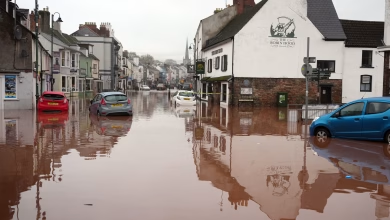
Climate Change has been noted for periodic droughts and food shortages in some parts of East Africa and even significant floods in parts of Europe.
What makes it a priority among global issues is the high level of associated unpredictability that it encompasses.
This therefore has serious implications on global trade, in a world that is more economically integrated than ever before and more susceptible to disruptions caused by exogenous factors.
– What are its social and political effects? and what is its impact on the demographics?
The most evident social effect of climate change is the disruption to livelihoods. This can be through the inaccessibility of adequate food, clean water, safe housing and disruptions to usual activities such as school and work.
The advent of climate change brings with it the likelihood of more frequent environmental disasters, and it therefore elevates the risks of social disturbance.
Politically, climate change has caused a renewed momentum among policy makers to take action now in order to protect their countries and provide a more sustainable footing to adapt or mitigate the effects.
To ignore the reality of the effect of climate change has now become a do-or-die political position for many prospecting candidates and world leaders, even though a very small minority of global leaders still deny the significance of its impacts.
– Does it have threats towards international community peace and security? Because it has become an issue that transcends the borders of countries?
Climate change will affect food security. Where there is a threat to food security borne by scarcity, there is bound to be conflicts in competing for those items.
Climate change has also led to the accelerated requirement of key resources that are used in the renewable industry.
One global power appears to have the lion’s share of these core commodities, and another power has set global sanctions and restricted on access to various types of technology.
This is a situation set for enhanced tensions and conflicts of one or many forms.
Instances like these definitely pose a threat to international peace and security.
– Has the environmental dimension become a major axis on the international agenda, just like the political and economic one?
Today’s global environmental agenda includes diverse internationally agreed-upon goals encompassing varied social and ecological challenges, including climate change, biodiversity and conservation.
Almost all of these areas are now known to drive or impact upon the core components of international trade, which in turn measures the demand for goods and services of any country across the globe and underscores their relative economic and pollical standing.
It means therefore that the considerations for the environment are part and parcel of the overall package of global importance alongside economic and political agendas, are of the highest priority.
– Are climate changes the cause of drought in Europe and what is happening to rivers and lakes around the world?
Evidence suggests that many of these ecological disruptions are still a mix of both climate and man-made developments.
For example, the inefficient use and insufficient harvesting of natural resources such as water to facilitate agricultural activities of various forms still contribute to limited supplies of water.
However, as the earth gets warmer, more water evaporates and naturally there is less of these resources to allocate for various uses.
Increased unpredictability of weather patterns and disaster related developments are also caused by the changing climate in which we live and therefore climate change plays a significant role in what is being observed in swollen rivers and lakes around the world.
– What is the importance of cop28 in the UAE and what is expected of it?
COP28 is of particular significance as it marks the conclusion of the first Global Stocktake, a comprehensive assessment of the progress made in achieving the goals of the Paris Agreement.
In terms of expectations, it must be understood that nothing progressive that occurred at COP27 in Egypt can overshadow the seriousness of the mounting pressure on COP 29 in the UAE.
Despite settlements on the creation of useful funds, for example through Loss and Damage facilities, and the increased climate considerations and concessional provisions from international development banks, the overarching factor that dwarfs these achievements is the inability to meet agreed upon climate targets.
However, COP remains an important vessel for the voices of vulnerable nations and a forum for efficient and effective representation via the established geographical blocs.
– With regard to the outputs of cop27..
COP27 did not advance the commitments or depict evidence of significant action by responsible parties to further reduce global emissions.
The annual meeting of COP is essential for progressing this key objective – without it, the world will not limit the global temperature rise to below 1.5 degrees Celsius. In considering these consistent shortfalls, it is fair to say that COP27 was a missed opportunity a reversal of momentum.
– How can the most important recommendation it made, which is the establishment of a fund for the affected countries, be implemented on the ground?
The Loss and Damage Fund acknowledges the need to reinforce vulnerable nations that are on the frontline of the battle against climate change; the ones that are literally observing the physical depletion of their shorelines and with very little resources to address the associated problems.
In March, the COP27 presidency held the first Transitional Committee meeting in Luxor, Egypt, to begin addressing the operationalization of the fund.
The composition of the committee ensured a diverse range of voices, and complex issues were discussed in a constructive spirit of cooperation.
The three-day meeting concluded with the adoption of a work plan containing substantive and procedural milestones to deliver actionable recommendations well in advance of COP28.
Backed by a broad range of government, civil-society, and private-sector stakeholders, the fund is designed to consider the short-, medium-, and long-term effects of climate change on developing countries; this is how it will closely align the broader policy to those affected on the ground.
Therefore, the operational aspects and implementation arrangements of the fund are relatively easy to accomplish with the vast number of professionals involved.
As with most climate-financed related initiatives, the difficulty lies in the ability of donors to hold true to their commitments.
– How is the Loss and Risk Fund funded?
The Transitional Committee will provide recommendations for the set up and operations of the fund.
The Committee will also recommend which countries should receive funding and who should be paying into the fund.
– Can the international community come up with solutions and apply them on the ground to confront climate change?
This depends on so many independent and interconnected factors that it is difficult to provide a wholesale prediction on the actual actions of the collective.
The sad reality is that despite the underlying principles of reciprocity and equality usually showcased in the UN system, it is highly unlikely that all countries will be on the same wavelength in terms in what they see as local and global priorities within the context of climate change and it is even more likely that where some recognize significant possibilities in carbon emissions, others may equate such developments to economic losses.
If all countries can commit to the preservation of the world, without economic and political pre-conditions, then I am confident that effective solutions can be arrived at.
– How can countries’ commitments to reduce greenhouse gases be implemented or monitored?
Currently countries submit reports called National Communications to the UNFCCC.
A national communication is a report that each Party to the Convention prepares periodically in accordance with the guidelines developed and adopted by the Conference of the Parties. Importantly, this report contains:
1) An inventory of greenhouse gas emissions by sources/sectors
2) A general outline of steps taken or envisaged by the country to implement the Convention
3) Any other information considered relevant for the overall calculations of global emission trends
The implementation deficits for the developing world largely result from a lack of technology, expertise and resources to meet or accelerate the specific targets.
Therefore in order to better advance the implementation of the GHG reduction there must be a simultaneous advancement in North-South collaboration, in order to realize the transfer of critical resources to the developing world.
– What steps has the Government of Barbados taken in response to the effects of climate change?
One can appreciate the fact that Barbados response has been mainly to the side adaptation measures to offset the forthcoming risks of climate change.
In doing so, a number of strategic initiatives have been adopted.
The most prominent feature has been its 2019 – 2030 Renewable Energy Policy, which focuses on rapidly transitioning the country to carbon neutrality by the year 2030.
Through government housing initiatives, Barbados has also instituted policies declaring access to clean renewable energy a right.
The government has partnered with the private sector and small businesses to create programmes that integrate grid-tied solar PV in new housing developments, thereby paving the way for easy ownership and participation in the renewable energy sector for the average household.
The government, through collaboration with the Caribbean Community Climate Change Center (based in Belize), has also embarked on a $45 million Green Climate Fund initiative which seeks to upgrade water networks across Barbados and integrate renewable energy and storage components to the established network, thereby providing a more responsible, sustainable and environmentally friendly way to distribute this critical resource across the island at a time when water scarcity, driven by climate change, is a real threat.
The government has also converted a significant proportion of its public transportation fleet to electrical vehicles, thereby reducing the operational carbon footprint of its fleet of buses.
Barbados boasts the highest number of electrical buses per capita in the world and it intends to further accelerate such achievements to the betterment of the environment.
Barbados amended the Planning and Development Act to improve the climate resilience of roads and fully operationalized the Barbados Environmental and Sustainability Fund (BESF) to support marine conservation.
the Parliament approved a new water re-use policy and the authorities also advanced important measures to incorporate climate considerations in the budget process.
– Do you think that the results of the Paris Climate Finance Summit are satisfactory for realizing the hopes and ambitions of developing countries, especially small island countries like yours?
Like most other person who actually take the outcomes of these summits into a historical context, I am cautiously optimistic about the prospects of significant changes.
The unspoken reality is that the direction of global climate progress resides in the control of a few countries that have a significant stake in the global financial infrastructure.
Coincidentally, these countries are also the largest emitters of green house gases and they also have the pleasure of currently experiencing trade surpluses with the rest of the world.
If my expectations are to truly change, it would occur against the backdrop of actions; tangible actions that have an immediate effect on the climate change targets.
There is always a place for dialogue on matters of such importance but while the dialogue ensues extensively, countries are becoming more submerged.
– What is the real impact of climate change on your country and other island states, and how do you see the reaction of the international community to this?
The impacts of climate change are more direct on small island states than other countries.
Most of us in the Caribbean region for example, rely heavily on tourism services and the beauty and ecological treasures of our countries to attract foreign exchange and maintain our financial standing in the global community.
The advent of warming temperatures and rising sea levels severely threaten the existence of these same attractions.
By extension, our ability to generate foreign exchange could be hampered and the livelihoods of persons in all sectors directly or indirectly affected by a fall in tourism activity are at stake.
Our countries to not produce notable quantities of highly desirable minerals to extract and export, so the ability to diversify our economies is more challenging than is large developed or developing nations.
– There are a lot of promises from Largest Countries to increase climate finance, so what is the volume of funds and financing you have received related to countering the effects of climate change over the past years, are there funds waiting to come in the near future, and what is the volume?
In recent time we have made use of collaborations with notable entities such as the Green Climate Fund, the International Monetary Fund, The Nature Conservancy, The Inter-American Development Bank and the World Bank.
Within the last 5 years the major influxes of financial resources targeting resilience activities in Barbados alone exceeded $410 million.
While Barbados is managing its resources dedicated to climate change in a prudent manner, there is a need for donor countries and financial institutions to do way more and to fully appreciate the context within which vulnerabilities in developing countries are hindered by risk-based exorbitant rates, which do much to hinder our preparation for the changing environment.
There has yet to be a climate change summit on the planet that has fully met its pledged support for this global effort, and while this may imply business-as-usual for many major players across the globe, it sadly signals a revelation of prioritization of economic fortunes over the livelihoods of those most affected by climate change.