Opening dialogue of climate change holded on

in coordination with the management of the 3rd Symposium of the scientific program of climate change (SPCC), under topic “Adaptation and mitigation strategies of the climate change impacts related to aquatic environment and human health” holding on Theodor Bilharz Research Institute (TBRI) an open dialogue as cooperation with the Department of Open Dialogues on Climate Change in the Arab Republic of Egypt (beyond COP27 to COP28), where held that addressed eight very important topics that are closely related to the issue of climate change, biodiversity and desertification (the three Rio Conventions), within the framework of raising capabilities in these important topics to achieve the mechanism of sustainable development and activate the benefits of the common environment, as well as the orientation towards use. Optimization of resources (responsible production and consumption, Goal 12 of the Sustainable Development Goals).
The event is sponsored and participated:
Prof. Dr. Mohamad Abbas Shemis, Acting Director of the Theodor Bilhars Research Institute and Chairman of the Board of Directors.
Prof. Dr. Nahed Mohamed Ismail, Professor of aquatic environment, technical supervisor of the climate change program at the Institute, and rapporteur of the symposium.


Prof. Dr. Ahmed Mohamed Abdullah Azzam, Acting Head of the Environmental Research Department.
Dr. Sarah Sayed Mahmoud, Assistant Professor in the Department of Environmental Research and Administrative Director of the Climate Change Program at the Institute ,Member of the organizing committee of the symposium.
First Session headed by:
Prof. Dr. Fawzy Rajab Mohamad Abdel Rahman
Prof. Dr. Hana Abdel Moneim
The Speakers:
• Prof. Dr. Sherine Zahran – National Center for Water Research
“Nexus Approach to mitigate with Climate Hazard”
• Prof. Dr. Zainab Salah Mahmoud – General Authority of Meteorology.
“The Projected Changes in the Climate of Egypt using the Climate Change Scenarios”
• Prof. Dr. Fawzy El-Essawy Younis – Professor and Head of the Territorial Physiology Unit – Desert Research Center
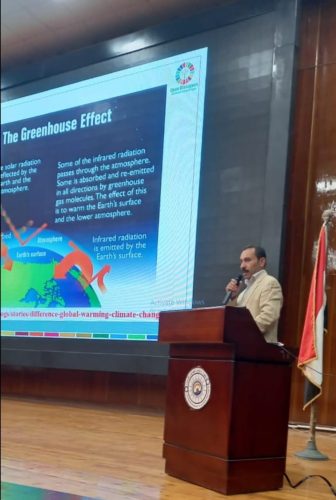
“How dose Climate Change Effect on Biodiversity?”
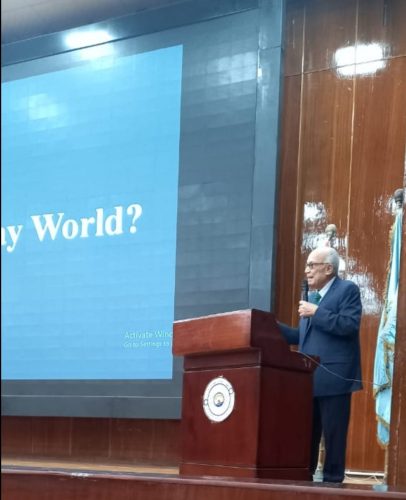
• Prof. Dr. Hani Abdel Salam – Professor of Marine Environment – Department of Zoology, Benha University
“Restoring Green Spirit in a Gray World”
• Prof. Dr. Hanan Ali Sayed Ibrahim – Professor of Public Health – Theodor Bilharz Research Institute.
“Climate Change and Woman Health”
Second session headed by:
Prof. Dr. Fatima Afifi Ali Al-Deeb
Prof. Dr. Hanan Ali Al-sayid
• Prof. Dr. Ahmed Azzam – Assistant Professor of Aquatic Ecology – Department of Environmental Research, Theodor Bilharz Research Institute.
“Impact of Climate Change on Water Resources in Egypt”
• Dr. Sherine Mahfouz – Researcher, Department of Malacology, Theodor Bilharz Research Institute.
“Historical Occurrence and Distribution of the snails Bulinus species according to Climate Change”
• Prof. Dr. Nahed Mohamed Ismail – Professor of Aquatic Environment – Department of Environmental Research, Theodor Bilharz Research Institute.
“What is required to be achieved in Egypt based on the results of COP 27”
Nowadays, society faces multiple challenges generated by climate change and accelerated by socio-economic developments such as population increase, urbanization and lifestyle changes, which together lead to multiple environmental, social and economic issues.
Knowledge and policy gaps among the water-energy-land-food nexus elements, which may even induce conflicts amongst its actors add to the above-mentioned issues, compromising the solutions devised by traditionally siloed policy-making processes.
Governance mechanisms should be implemented to:
• Highlight the interaction between different sectors under different pressures (social, economic, climate, etc.)
• Understand the local needs and interests of relevant stakeholders and balance pre-existing power structures.
• Ensure the provision of transparent information on the interconnections, their interactions and related decision-making processes
• Activate the interconnection between different sectors (energy, water and food security) when possible and activate a collective agreement on sustainable resource management.
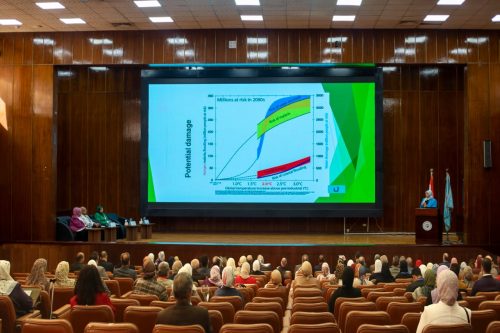
The Recomenation:
• Risk and vulnerabilities awareness: Households and communities demonstrated their ability to adapt to extreme events and the few vulnerabilities they directly experienced.
Meanwhile, other risks that cause extreme events, such as melting Arctic Sea ice, have not been directly targeted, which implies a lack of information about the interconnections between cascading natural hazards and vulnerabilities.
• Responding to food versus water and energy needs: Evidence suggests that communities are responding more urgently to food security needs due to the current impacts of climate change.
• The need for more information and capacity building to understand future needs to adapt to climate change and to achieve water, energy and food security.
• Re-searching and releasing high-yielding, biotic and abiotic stress resistant, and suitable varieties across agro-ecologies were recommended as a major adaptation and mitigations strategies for CC impacts globally.
• Accordingly, varieties that could withstand both biotic and abiotic stresses and CC must be accessible at a larger scale with adequate financial and policy support.
• Improving natural resources management and use practices, maintaining agro-biodiversity and implementation of climate-smart agriculture are a must.
• Applying biodiversity conservation strategies and performing land restoration programs at a larger large scale are suggested.
• Therefore, future research and development should focus on the researching and innovation of climate-resilient technologies, alternative and carbon neutral energy sources, use of bio-energies.