
By: Shohre Sadri
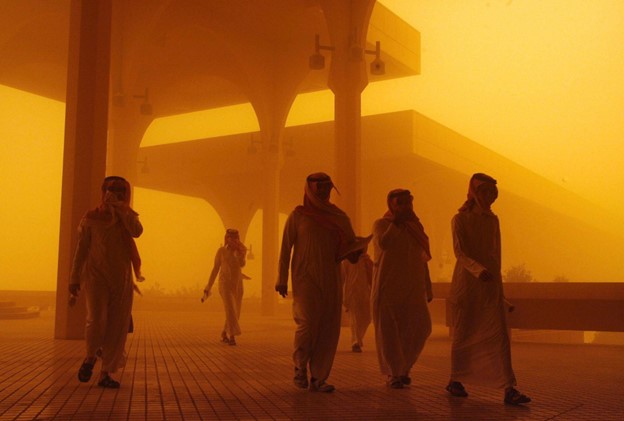
Hoor- Al Hawizeh / Al-Azim marshes are drawing their last breaths. Prolonged droughts, reduced water in the wetland, migration of people, and dust. The dry earth turns to dust, carried into the sky.
Due to droughts in previous years and their impact on agricultural lands, as well as the reduction of water flow in the Tigris and Euphrates basins, dust centers in the Tigris and Euphrates basins have become more active.
According to a study published by the Aeolian Research journal, Dr. Ali Darvishi, Professor at the University of Tehran and UN-Habitat consultant on controlling dust centers, mentioned that in the past 20 years, about 11,000 dust events have occurred in the Tigris and Euphrates basins.
It should be noted that dust is not solely a national issue; it is an interregional problem. Iran, Iraq, and Kuwait, located downstream of the Tigris and Euphrates basins, are constantly affected by dust hotspots. Communities around the Hoor-al-Azim marshes in Iran and Iraq are particularly vulnerable, as the marshes’ drying has turned them into one of the region’s major sources of dust. Damage to agricultural crops, respiratory diseases, and the migration of people from this region have intensified due to dust.

Despite the intensification of dust events in recent years, international cooperation among countries in the region remains limited. According to the latest statement by the responsible official in Iran’s Department of Environment, joint actions between Iran and Iraq to control dust storms have remained at the level of holding joint meetings and have not yet reached the stage of executive action. Therefore, the time has come for the people of this region, with local solidarity and action, to demand that their governments take action for international and interregional cooperation to contain and control dust.
For this purpose, we ask all the people, including farmers, women, students, children, teenagers, NGOs and other residents of Hoor-al-Azim, to raise awareness about dust storms in their communities by showcasing the dust situation in their local area through mass media using relevant hashtags. This will attract public attention to this important issue and encourage them to urge their local and national governments to take urgent action to contain and reduce dust storms.
The dust hotspots are common to the countries in the region, and regional cooperation is necessary to control them. Losing today’s opportunity means the formation of a greater catastrophe resulting from the impacts of dust storms on the lives of the region’s people.
Ref:
- Ali Darvishi Boloorani, Saham Mirzaei, Hossein Ali Bahrami, Masoud Soleimani, Najmeh Neysani Samany, Ramin Papi, Maryam Mahmoudi, Mohsen Bakhtiari, Alfredo Huete, In vitro plant spectral response reveals dust stress, Agricultural and Forest Meteorology,Volume 370,2025,
- Ali Darvishi Boloorani, NN Samany, R Papi, M Soleimani – Dust source susceptibility mapping in Tigris and Euphrates basin using remotely sensed imagery; Catena, Volume 209, 2022
- https://www.isna.ir/news/1403110201531


