Font Type:
أريال جورجيا فيردانا
حجم الخط:
آآآآآآ
تباعد الأسطر:
عرض العمود:
خلفية:
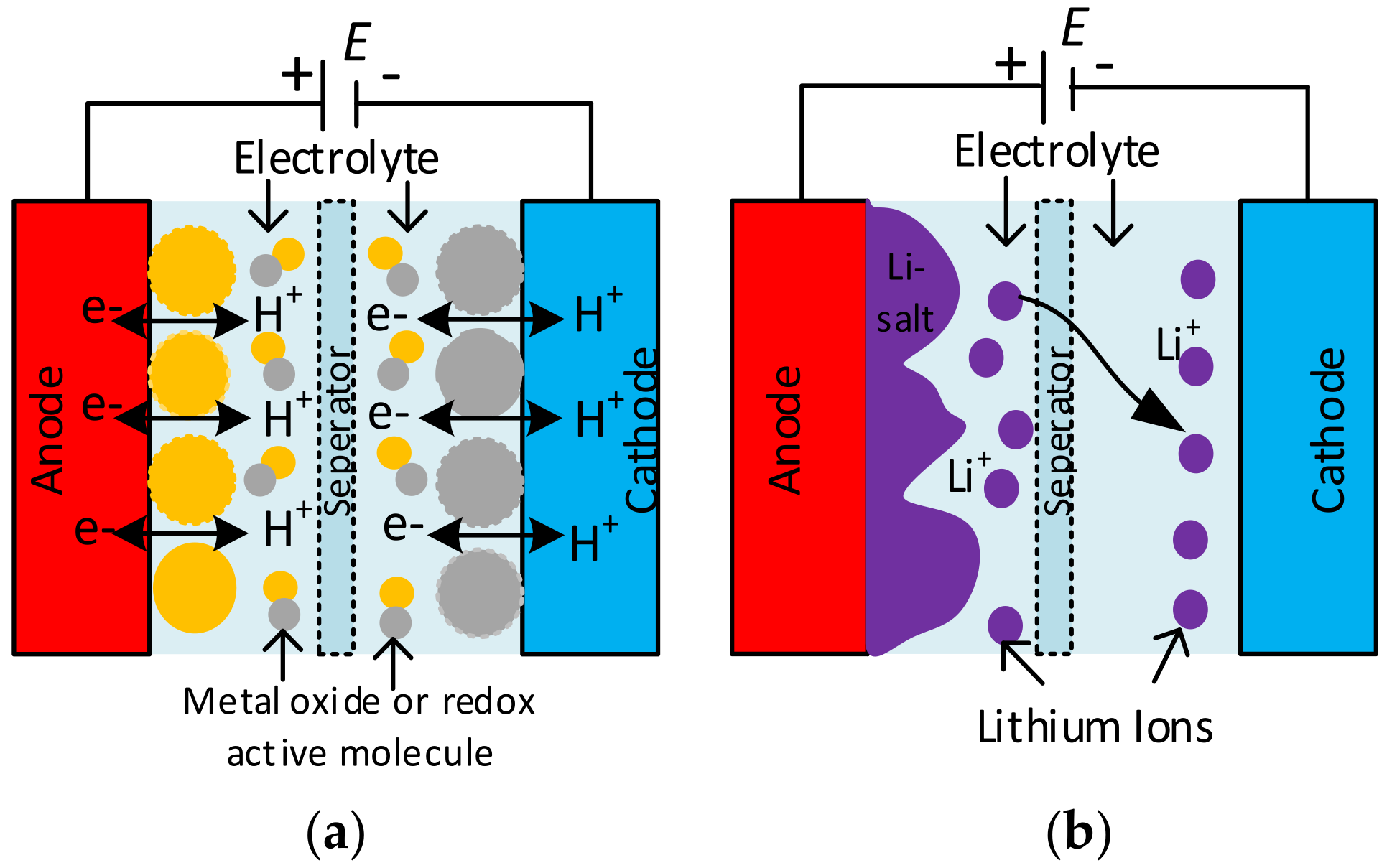
الشكل 3. ( أ ) تكوين المكثف الزائف (PC) و ( ب ) المكثف الفائق الهجين (HSC) [ 109 ].
الطاقات 15 00674 g003
تحميل...
مراجعة

مراجعة شاملة لتطبيقات وتطورات المكثفات الفائقة

بواسطة 1،*،2و2
1
قسم الهندسة الكهربائية والإلكترونية، جامعة رجب طيب أردوغان، ريزي 53100، تركيا
2
قسم تكنولوجيا الطاقة، جامعة ألبورج، بونتوبيدانتسترايد، 9220 ألبورج، الدنمارك
*
المؤلف الذي ينبغي توجيه المراسلات إليه.
الطاقات 2022 ، 15 (3)، 674؛ https://doi.org/10.3390/en15030674
تاريخ استلام التقديم: ١٢ أكتوبر ٢٠٢١ / تمت المراجعة: ٢١ نوفمبر ٢٠٢١ / تم القبول: 1 يناير 2022 / نُشر في: ١٨ يناير ٢٠٢٢

خلاصة

The storage of enormous energies is a significant challenge for electrical generation. Researchers have studied energy storage methods and increased efficiency for many years. In recent years, researchers have been exploring new materials and techniques to store more significant amounts of energy more efficiently. In particular, renewable energy sources and electric vehicle technologies are triggering these scientific studies. Scientists and manufacturers recently proposed the supercapacitor (SC) as an alternating or hybrid storage device. This paper aims to provide a comprehensive review of SC applications and their developments. Accordingly, a detailed literature review was first carried out. The historical results of SCs are revealed in this paper. The structure, working principle, and materials of SC are given in detail to be analysed more effectively. The advantages and disadvantages, market profile, and new technologies with manufacturer corporations are investigated to produce a techno-economic analysis of SCs. The electric vehicle, power systems, hybrid energy storage systems with integration of renewable energy sources, and other applications of SCs are investigated in this paper. Additionally, SC modelling design principles with charge and discharge tests are explored. Other components and their price to produce a compact module for high power density are also investigated.

1. Introduction

الأحداث الطبيعية المتكررة والوقود الأحفوري هي مصادر الطاقة الأساسية. تخزين وتنظيم الطاقة هي مشكلة فورية لهذه المصادر [ 1 ]. يجب أن تحافظ الطاقة على إمكاناتها الهائلة الحجم لتزويدها دون انقطاع [ 2 ]. يتم تحويل مصادر الطاقة إلى أشكال مختلفة وتخزينها جزئيًا في نظام الشبكة لتقليل ذروة الطاقة [ 3 ]. علاوة على ذلك، يمكن تخزين هذه المصادر للفجوات القابلة للانقطاع والزمنية بين توليد الطاقة واستهلاك المستخدم النهائي [ 4 ]. تخزين طاقة المياه في السدود [ 5 ] وتخزين الطاقة على شكل هيدروجين [ 6 ] وأجهزة التخزين الكهروكيميائية [ 7 ] هي أنظمة التخزين الأساسية المستخدمة اليوم. من الممكن تخزين الطاقة كطاقة كهربائية مباشرة باستخدام أجهزة التخزين الكهروكيميائية [ 3 ، 8 ]. ومع ذلك، فإن عمر أجهزة التخزين التقليدية هذه أقل من نصف عمر المكثف الفائق (SC)، ومعظمها يحتوي على بعض الملوثات الضارة بالطبيعة، ولديها بعض العيوب الفنية [ 8 ، 9 ]. على الرغم من أن بطاريات التدفق القائمة على الحديد لها عمر طويل وهي صديقة للبيئة، إلا أن كثافة الطاقة لديها أقل بسبب العديد من المحاليل المائية [ 8 ]. وبالتالي، كان العلماء يبحثون في أجهزة التخزين ذات السعة الكبيرة والعمر الطويل لسنوات عديدة [ 10 ، 11 ].
اقترح العلماء الخلايا الجذعية كحل بديل للتطبيقات الفردية والهجينة مع أجهزة تخزين أخرى [ 12 ]. بالإضافة إلى ذلك، كمصدر للطاقة للمركبات الكهربائية والهجينة، تُستخدم الخلايا الجذعية بشكل متزايد كمخزن مؤقت للطاقة للفرامل المتجددة [ 13 ]. تتمتع الخلايا الجذعية بالعديد من المزايا، بما في ذلك كثافة الطاقة العالية، ووقت الشحن والتفريغ السريع، ومقاومة الإدخال المنخفضة، وعمر افتراضي ممتد، وهي صديقة للبيئة [ 3 ، 14 ]. تم اقتراح وتطبيق العديد من طوبولوجيات التهجين خلال العقد الماضي لزيادة كثافة الطاقة وعمر دورة أنظمة تخزين الطاقة [ 15 ، 16 ، 17 ، 18 ]. تحفز أحدث التقنيات وضع الخلايا الجذعية في منافسة مباشرة مع البطاريات القابلة لإعادة الشحن [ 19 ]. وبالتالي، تم التحقيق في الأنشطة الكهروكيميائية لبعض المواد ومركباتها للحصول على طرق محتملة لتطبيق هذه المواد في بطاريات ليثيوم أيون في المستقبل [ 9 ، 19 ]. يمكن للخلايا الجذعية تخزين الطاقة الكهربائية كجهاز الحالة الصلبة للتغلب على العديد من أوجه القصور في البطاريات [ 13 ].
تم اختراع المكثفات ذات الحالة الصلبة في منتصف القرن التاسع عشر، ولها تاريخ جديد. أولاً، صمم مهندسو شركة جنرال إلكتريك (GE) المكثفات في أوائل الخمسينيات و1957. تم تطوير أول مكثف ذات حالة صلبة بدون طبقة مزدوجة معروفة بواسطة بيكر [ 20 ]. قامت شركة SOHIO بتوسيع نسخة أخرى من المكثف ذات الحالة الصلبة في عام 1966، وتم تسجيل براءة اختراعها كمكثف كهربائي [ 21 ، 22 ]. تم تطوير أول مكثفات ذات حالة صلبة للتطبيقات العسكرية بواسطة معهد بيناكل للأبحاث (PRI) في عام 1982، والتي تسمى مكثفات PRI الفائقة. في نهاية عام 1980، زادت تيارات الشحن والتفريغ، اعتمادًا على زيادة قيم السعة، وانخفضت قيم المقاومة التسلسلية المكافئة (ESR). في عام 1992، تولت مختبرات ماكسويل هذا التطوير وأطلقت عليها اسم "مكثفات التعزيز" للتأكيد على تطبيقات الطاقة الخاصة بها [ 23 ]. قام إيفانز بتطوير مكثف كهربائي عالي الجهد من التنتالوم في عام 1994، والذي جمع بين خصائص المكثفات الكهربائية والكهروكيميائية؛ ومع ذلك، فقد اقتصر على تطبيقات عسكرية محددة [ 24 ، 25 ]. تجمع مكثفات أيون الليثيوم التي طورتها مؤخرًا شركة مجموعة FDK، والتي تسمى المكثفات الهجينة، بين قطب كربون كهروستاتيكي وقطب كهروكيميائي لزيادة قيمة السعة [ 26 ، 27 ]. تهدف أبحاث SC اليوم إلى تحسين خصائص SC وزيادة الأداء وتقليل تكاليف الإنتاج [ 28 ، 29 ].
يختلف هيكل SC عن المكثف الخزفي أو الإلكتروليتي. يتكون من قطبين صلبين مستقطبين بجهد مطبق ومفصولين بواسطة فاصل غشائي وإلكتروليت سائل [ 30 ، 31 ]. يتكون مكثف الطبقة المزدوجة الكهربائية (EDL)، والذي يُسمى أيضًا المكثف الفائق، من أيونات في الإلكتروليت تشكل مكثفات طبقة مزدوجة كهربائية ذات قطبية معاكسة للأقطاب [ 3 ، 30 ]. تُعد السعة ثنائية الطبقة أحد مبدأي التخزين، حيث يتم تحقيق التخزين الكهروستاتيكي عن طريق فصل الشحنة في طبقة هلمهولتز المزدوجة وزيادة سعة SCs [ 32 ، 33 ]. النوع الآخر من التخزين الكهروكيميائي هو السعة الزائفة، والتي يتم الوصول إليها من خلال تفاعلات الأكسدة والاختزال الفارادية. لا يمكن فصل هذين المبدأين إلا من خلال تقنيات القياس [ 23 ].
تنشأ وظائف وخصائص SC من التأثير المتبادل لمواد الأقطاب والإلكتروليتات الخاصة بها. عادةً ما تكون مادة القطب لمكثفات EDL عبارة عن الكربون المنشط وقماش ألياف الكربون والهلام الهوائي والجرافيت والجرافين وأنابيب الكربون النانوية في مظاهر مختلفة من الكربون [ 33 ، 34 ، 35 ]. تستخدم المادة شبه السعوية بوليمرات موصلة للإلكترون ذات معدل ESR منخفض وسعة عالية ودورات، لأنه لا يمكن استخدام كل مادة كقطب للمكثفات الكاذبة [ 36 ، 37 ]. تجمع SCs من النوع الهجين بين قطبين بسعة زائفة عالية وسعة مزدوجة الطبقة مصنوعة من مواد قائمة على الكربون [ 38 ]. أثر تطوير أقطاب المكثفات الفائقة من النوع الهجين على أقطاب البطاريات القابلة لإعادة الشحن [ 39 ] بشكل إيجابي. فيما يتعلق بمواد الإلكتروليت، تتكون الإلكتروليتات من مذيب ومواد كيميائية مذابة. لتحسين التوصيل الكهربائي، يلزم وجود المزيد من الأيونات في الإلكتروليتات والمحاليل المائية والعضوية والأيونية المستخدمة [ 40 ]. يُفصل القطبان فيزيائيًا بواسطة فواصل لمنع حدوث ماس كهربائي، ويجب أن يكونا رفيعين ومساميين لتقليل المقاومة التسلسلية المكافئة (ESR). بشكل عام، تُستخدم مكونات غير مكلفة للفواصل؛ بينما تستخدم التصميمات الأكثر تعقيدًا أغشية بوليمرية مسامية غير منسوجة، أو ألياف زجاجية منسوجة، أو ألياف سيراميك منسوجة مسامية [ 41 ]. وأخيرًا، تتصل الأقطاب الكهربائية بمجمعات التيار في أطراف المكثف لتوزيع تيارات الذروة العالية.
تجعل مزايا الخلايا الشمسية متفوقة على أجهزة التخزين الأخرى، في حين أن لها أيضًا بعض العيوب. بمقارنة الفوائد والعيوب، يبدو من المعقول استخدامها معًا [ 3 ، 14 ]. ترتبط مزايا وعيوب أجهزة التخزين الكهروكيميائية المختلفة بقيم كثافة الطاقة والقدرة وفترة الشحن [ 42 ]. تمت مقارنة تحليلات أداء الخلايا الشمسية بأجهزة التخزين الأخرى في العديد من الدراسات، والتي أظهرت أن استخدام الخلايا الشمسية مع أجهزة التخزين الأخرى أمر معقول من نواحٍ عديدة [ 43 ، 44 ، 45 ]. تم التحقيق في هذه التفوقات لأنظمة تخزين الطاقة الهجينة الكهروضوئية (PV) - البطارية الخلايا الشمسية أو خلايا الوقود بما في ذلك أنظمة تخزين الطاقة الهجينة ( HESSs ) في بعض الدراسات [ 49 ، 50 ] . قامت بعض الدراسات بمحاكاة ومقارنة أنظمة HESS من حيث عمر البطارية والتكاليف اليومية [ 12 ، 43 ]. وقد أعطت تحليلات الأداء والتكلفة نتائج أفضل لـ SCs بما في ذلك أنظمة HESS [ 51 ، 52 ، 53 ].
الشركات التجارية وحالات المنتجات وهيكل السوق والتطورات الجديدة في السوق هي النقاط الأساسية الأخرى التي يجب التحقيق فيها بمزيد من التفصيل لتوضيح الاتجاه المستقبلي لـ SCs. بلغت مبيعات SC العالمية حوالي 400 مليون دولار أمريكي منذ عام 2016 [ 54 ]. نما سوق البطاريات من 47.5 مليار إلى 95 مليار دولار أمريكي [ 55 ]. لا يزال سوق SC صغيرًا؛ ومع ذلك، فمن المتوقع أن تنمو المبيعات بزيادة سنوية تبلغ حوالي 24٪، من 240 مليون إلى 2 مليار دولار أمريكي بحلول عام 2026 [ 56 ]. بلغت تكاليف SC في عام 2006 0.01 دولار أمريكي/F أو 2.85 دولار أمريكي/kJ، وانتقلت في عام 2008 إلى أقل من 0.01 دولار أمريكي/F، وتنخفض كل عام [ 57 ]. تحتوي المكثفات الكهربائية ثنائية الطبقة الحالية (EDLCs) على إلكتروليتات عضوية تعمل عند 2.7 فولت وتصل إلى كثافة طاقة تتراوح بين 5-8 واط/كجم أو 7-10 واط/لتر [ 58 ]. واليوم، تقدم إحدى الشركات التجارية وحدة مكثف فائق 48 فولت مع 1,000,000 دورة عمل أو عمر تيار مستمر لمدة عشر سنوات وجهد تشغيل تيار مستمر 48 فولت [ 59 ]. تم تصميم الوحدات خصيصًا للحافلات الهجينة ومعدات البناء لتوفير حلول فعالة من حيث التكلفة. ومع ذلك، فهي تُستخدم أيضًا على نطاق واسع في تطبيقات الإلكترونيات لموازنة الخلايا [ 60 ، 61 ].
تتمتع SC ببعض المزايا في التطبيقات ذات كثافة الطاقة العالية، ويتطلب الأمر العديد من دورات الشحن والتفريغ لعمر أطول. التطبيقات العامة لـ SCs هي لفترات أقصر من الطاقة المنخفضة إلى العالية، ولا تُستخدم للتيارات المتناوبة (AC). توجد بعض تطبيقات SCs في الإلكترونيات الاستهلاكية [ 62 ، 63 ] والأدوات وإمدادات الطاقة [ 64 ] وتثبيت الجهد [ 65 ] والشبكات الصغيرة [ 66 ] وتخزين الطاقة المتجددة [ 3 ] وحصاد الطاقة [ 67 ، 68 ] ومصابيح الشوارع [ 69 ] والتطبيقات الطبية [ 70 ] والتطبيقات العسكرية والسيارات [ 71 ، 72 ، 73 ] واستعادة الطاقة [ 74 ، 75 ، 76 ، 77 ]. سيتم استكشاف هذه بمزيد من التفصيل مع الأمثلة في الأقسام التالية. هناك حاجة إلى بروتوكولات اختبار موحدة للتطبيقات التي تتراوح من التيارات المنخفضة إلى العالية الذروة [ 78 ]. وقد حسب تقرير حالي أنه إذا استخدمت نسبة قليلة فقط من أنظمة الهجين المعتدلة 48 فولت تقنية حلاقة الذروة في الخلايا الشمسية خلال عشر سنوات، فسوف تنشأ سوق إضافية سنوية للخلايا الشمسية تزيد قيمتها عن 0.5 مليار دولار أمريكي في عام 2030 [ 79 ].
نمذجة SC ومحاكاة الشحنة والتفريغ لتحديد السعة والمقاومة الداخلية هي موضوع بحث آخر. تم العثور على بعض الدراسات الأولية في الأدبيات حيث تم التحقيق في الخصائص المختلفة والبنية الديناميكية لـ SCs ومحاكاتها [ 80، 81، 82، 83، 84، 85، 86 ] . صمم زوبيتا وفاراندا نموذج دائرة كهربائية مكافئة لمحاكاة مناسبة لتطبيقات الطاقة [ 87 ، 88 ]. في دراسات أخرى ، تم استخدام نموذج دائرة كهربائية ثنائي الفروع لمحاكاة وحدة SC [ 89 ، 90 ، 91 ]. كما تمت مناقشة طريقة تستخدم لتحديد بعض معلمات دائرة SC المكافئة تجريبياً في الأدبيات [ 90 ، 92 ]. مطلوب نموذج وحدة SC مبسط في عمليات المحاكاة في الوقت الفعلي [ 93 ]. يتم إنشاء SCs بناءً على نموذج دائرة مكافئة مبسط للتحقيق في أداء مكدس SC [ 93 ، 94 ]. هذه المجموعة، والتي تسمى وحدة، مصممة خصيصًا لتوفير حلول لتطبيقات الإلكترونيات الصناعية [ 59 ، 93 ]. تم تصميم وحدة باستخدام 20 قطعة من خلايا SC 310 F و 2.7 V. تم إجراء اختبارات الشحن والتفريغ لظروف الحمل المختلفة لكل مكثف ووحدة وتم تأكيدها بنتائج المحاكاة [ 95 ]. موضوع آخر يتعلق بتطوير خلايا SC هو تجميع وتصنيع خلايا SC. تصميمات خلايا SC الثلاثة واسعة الانتشار المستخدمة تجاريًا هي الخلايا المعدنية والخلايا الأسطوانية والخلايا الجيبية. [ 96 ، 97 ، 98 ، 99 ].
تهدف هذه الورقة إلى دراسة أنظمة الطاقة الشمسية من جوانب متعددة، وعرض النتائج للقراء. بدايةً، تم تفصيل تاريخ وتطور أنظمة الطاقة الشمسية في المقدمة. أما القسم الثاني، فيتناول هيكل أنظمة الطاقة الشمسية، ومبادئ عملها، وموادها. أما القسم الثالث، فيتناول التحليلات التقنية والاقتصادية لأنظمة الطاقة الشمسية، والتي تشمل المزايا، وتحليلات السوق، والاتجاهات والتقنيات الجديدة، وشركات التصنيع. أما القسم الرابع، فيتناول المركبات الكهربائية، وأنظمة الطاقة، والأنظمة الهجينة، وتطبيقات أنظمة الطاقة الشمسية الأخرى. أما الأقسام الأخيرة، فتتناول متطلبات نموذج أنظمة الطاقة الشمسية، وتصميم الوحدة، واختبارات الشحن والتفريغ، ومكوناتها الأخرى، وتحليلات أسعار الأنظمة المدمجة.

2. أساسيات المكثفات الفائقة

2.1. الهيكل والمواصفات

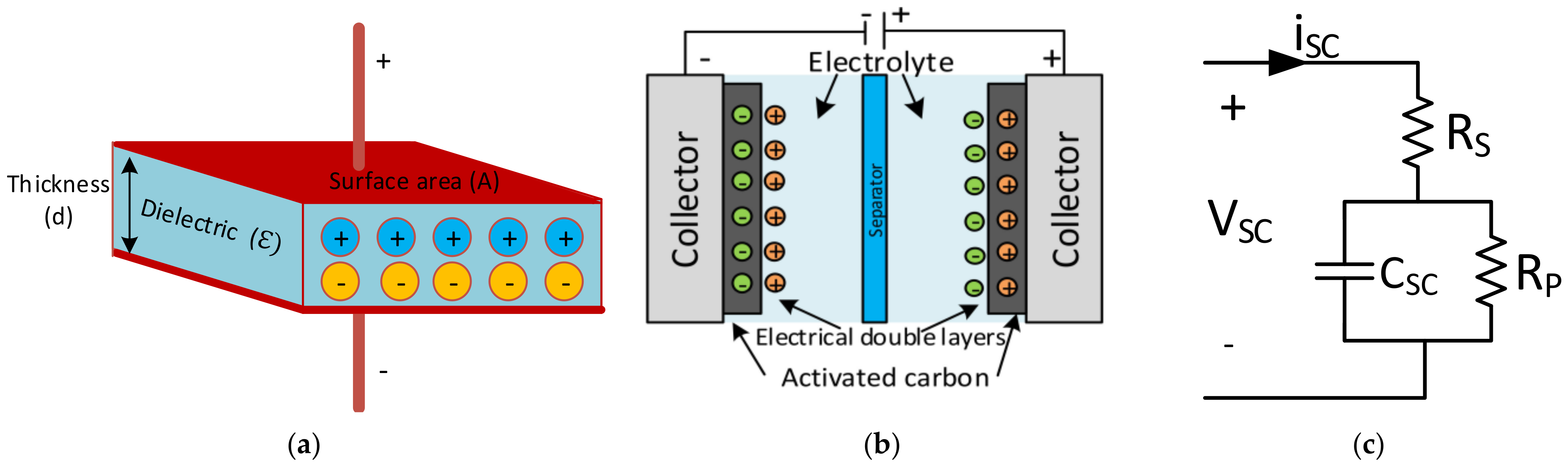
يُلخّص هذا القسم بنية المكثفات الكهروستاتيكية، ومبدأ عملها، ومواصفاتها، وتصنيفاتها، وموادها. يعتمد المفهوم الأساسي للمكثفات الكهروستاتيكية على المكثفات الكهروستاتيكية، وهو مُوضّح في المعادلة (1). في هذه المعادلة، تُوضّح نفاذية الهواء ( ε 0 )، والنفاذية النسبية للمادة العازلة ( ε r )، ومساحة السطح ( A )، والمسافة بين قطبين كهربائيين ( d ) في الشكل 1 أ [ 94 ]. تُعدّل السعة بتغيير مساحة سطح المادة العازلة وسمكها وفقًا للعلاقة الواردة في المعادلة (1).
ج=ε0×εر×أد
الشكل 1. ( أ ) بنية المكثف الكهروستاتيكي [ 94 ]، ( ب ) بنية المكثف الكهروستاتيكي [ 101 ]، ( ج ) نموذج الدائرة المكافئة للمكثف الكهروستاتيكي [ 102 ].
يتكون الهيكل الأساسي للخلية ذات الشحنة الواحدة من مجمعات تيار من الألومنيوم وأقطاب كهربائية بدلاً من المواد العازلة. يعتمد مبدأ تشغيلها على تخزين الطاقة عن طريق توزيع الأيونات بالقرب من سطح القطبين الكهربائيين. تُنشئ الواجهتان منطقة شحن فراغية تُسمى الطبقة الكهربائية المزدوجة (EDL)، كما هو موضح في الشكل 1 ب. لذلك، تكون الخلية ذات شحنة كهربائية ساكنة، ولا يحدث فيها أي تفاعل كهروكيميائي [ 100 ، 101 ].
نموذج الدائرة الكهربائية المكافئة لدائرة SC موضح في الشكل 1 ج. هنا، ترمز المقاومة المتسلسلة ( Rs ) للمكثف إلى المقاومة المتسلسلة المكافئة (ESR). في المقابل، تمثل المقاومة المتوازية ( Rp ) عبر المكثف المقاومة المقدرة وفقًا لتيارات التسرب، وتمثل السعة ( C SC ) السعة الكلية لدوائر SC. يمكن استخدام المعلمات المذكورة في بيانات الكتالوج لحساب أقصى تيار ذروة في ثانية وقيمة القدرة القصوى المحددة، كما هو موضح في المعادلتين (2) و(3) [ 102 ].
الحد الأقصى قمة حاضِر 1ثانية=12.ج.الخامسج.معدل ترسيب كرات الدم الحمراءدي سي+1
 صالأعلى محدد قوة=الخامس24.معدل ترسيب كرات الدم الحمراءدي سي.كتلة
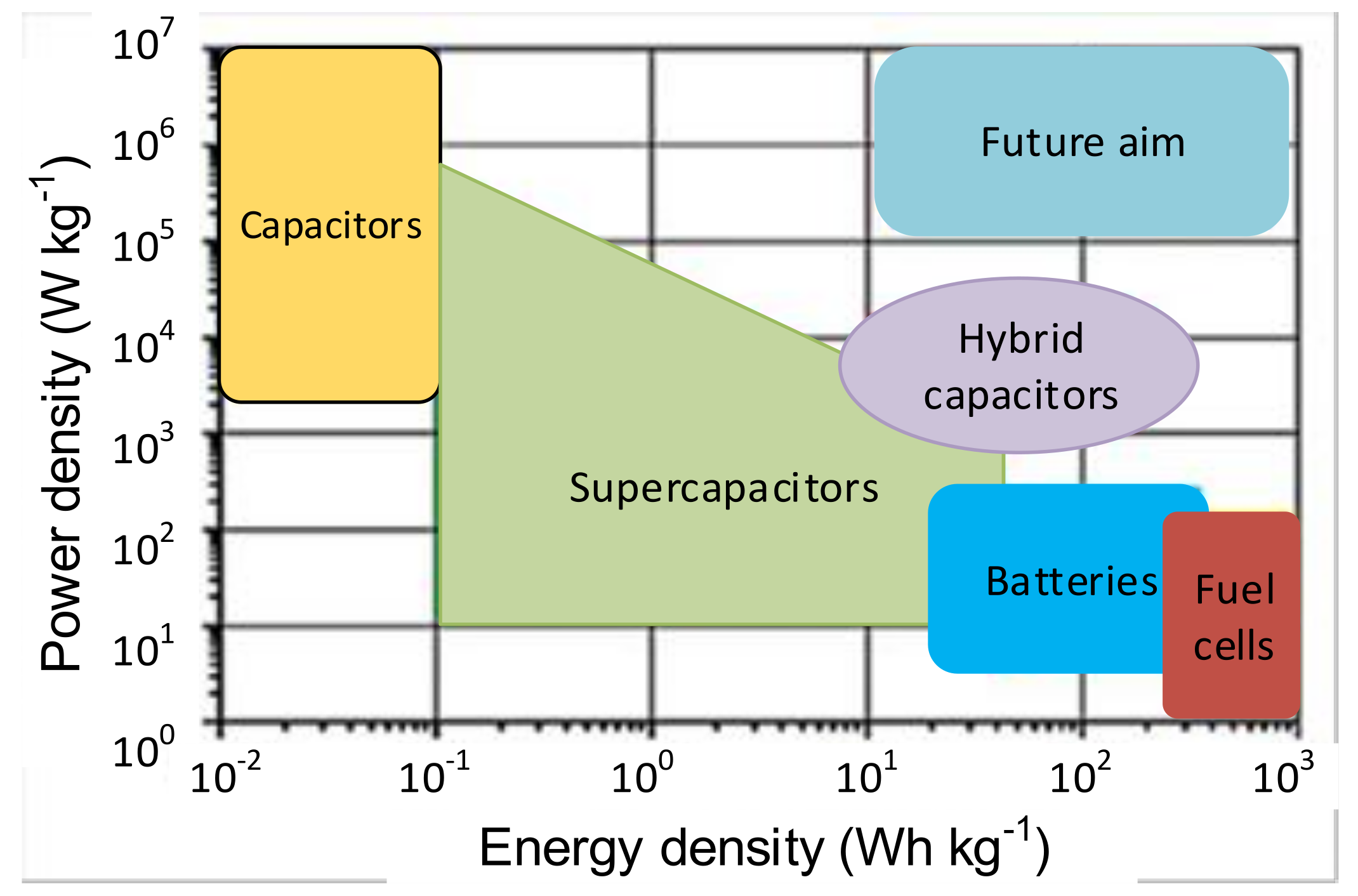
الخصائص الرئيسية لخلايا SC هي انخفاض الطاقة وكثافة الطاقة العالية والشحن والتفريغ السريع وإنهاء تدفق الطاقة عند الشحن الكامل ومقاومة داخلية ضئيلة (ESR) وعمر تخزين طويل وعمر افتراضي ممتد. تجعل مزايا خلايا SC متفوقة على أجهزة التخزين التقليدية الأخرى في نواحٍ عديدة. بمقارنة تميزاتها وعيوبها، يبدو أن استخدام خلايا SC مع أجهزة تخزين أخرى مناسب [ 42 ]. خلايا SC هي مكونات ذات جهد منخفض وتتطلب تشغيلًا آمنًا، حيث يظل الجهد ضمن حدود محددة. يتم تصنيف خلايا SC القياسية ذات الإلكتروليتات المائية ضمن نطاق جهد يتراوح من 2.1 إلى 2.3 فولت، ويتم تصنيف خلايا SC ذات المذيبات العضوية من 2.5 إلى 2.7 فولت [ 40 ]. بالنسبة لمتطلبات الجهد الأعلى، يتم توصيل خلايا SC على التوالي. تتراوح قيمة السعة المقدرة بين 1 فهرنهايت إلى 1000 فهرنهايت؛ بالنسبة للتطبيقات الأعلى، تكون السعات مطلوبة لتوصيل خلايا SC بالتوازي [ 3 ، 95 ]. يوضح الشكل 2 أن الخلايا الجذعية قادرة على ربط البطاريات والمكثفات [ 94 ، 103 ، 104 ]. كثافة الطاقة في الخلايا الجذعية أكبر من تلك الموجودة في المكثفات التقليدية؛ ومع ذلك، فإن كثافة الطاقة في المكثفات أكبر من تلك الموجودة في الخلايا الجذعية.
الشكل 2. مقارنة كثافة الطاقة والقدرة لأجهزة التخزين [ 103 ].

2.2. التصنيفات

يمكن تصنيف SCs بناءً على تفاصيل تصنيعها وبنائها. يمكن تصنيع SCs في أشكال مسطحة أو أسطوانية أو مستطيلة [ 105 ، 106 ]. يعتمد مبدأ تشغيل SCs على تخزين الطاقة، وبناءً على طريقة تخزين الطاقة، يتم تقسيم SCs إلى ثلاث مجموعات رئيسية. يمكن تقسيم SCs إلى EDLCs و pseudocapacitors (PCs) بناءً على طريقة تخزين الطاقة. يحدث تخزين الشحنة بين الإلكتروليت والأقطاب الكهربائية في EDLC، كما هو موضح في الشكل 1 ب. تتضمن PCs تفاعلات أكسدة فارادية عكسية وسريعة للشحنة من أجل زيادة سعة SC، كما هو موضح في الشكل 3 أ. يخزن المكثف الفائق الهجين (HSC) الشحنات عن طريق مطابقة قطب الكربون السعوي مع قطب شبه سعوي أو قطب إدخال الليثيوم، كما هو موضح في الشكل 3 ب [ 107 ، 108 ، 109 ].
الشكل 3. ( أ ) تكوين المكثف الزائف (PC) و ( ب ) المكثف الفائق الهجين (HSC) [ 109 ].
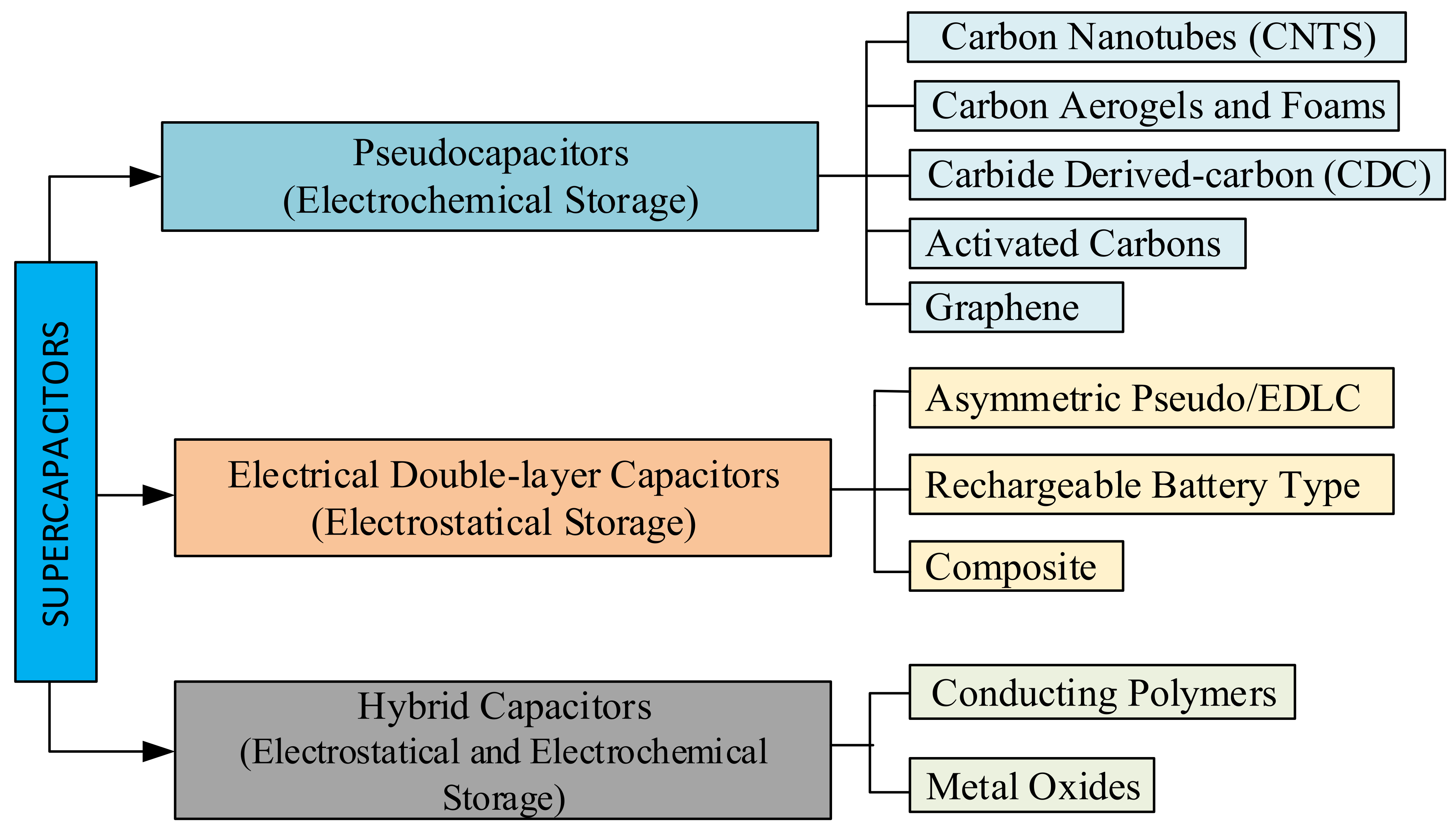
تتكون EDLCs من مادتين كهربائيتين قائمتين على الكربون، وكمية كافية من الإلكتروليتات، وفاصل. يمكن لـ EDLCs تخزين الشحنات إما كهروستاتيكيًا أو عبر طريقة غير فاراداي، دون نقل أحمال الشحنة باستخدام مبدأ تخزين الطبقة المزدوجة الكهروكيميائية [ 108 ، 110 ، 111 ]. تتمتع الأنواع الثلاثة الرئيسية من EDLCs بحالة محددة لمادة الكربون. الأنابيب النانوية الكربونية (CNTs)، والجرافين، والهلام الهوائي الكربوني والرغوة، والكربون المشتق من الكربيد (CDC)، والكربون المنشط هي الأنواع الرئيسية للمكثفات الكاذبة، كما هو موضح في الشكل 4. [ 100 ]. تخزن أجهزة الكمبيوتر الشحنات عبر عملية فاراداي تتضمن نقل أحمال الشحنة كهروستاتيكيًا [ 112 ]. عندما يتم تطبيق جهد على المكثفات الكاذبة، يحدث الاختزال والأكسدة في مادة القطب ويمر تيار فاراداي عبر خلية SC. تؤدي عملية فارادا هذه إلى مكثفات زائفة ذات كثافات طاقة أعلى من مكثفات EDLC. يتضمن هذا النوع من المكثفات أكاسيد معدنية وكربون مشوب بالمعادن ومواد أقطاب كهربائية بوليمرية موصلة [ 113 ]. تتميز أنواع البوليمرات الموصلة من SCs بسعة عالية وESR منخفض وتكلفة منخفضة مقارنة بـ EDLCs القائمة على الكربون. ومع ذلك، فإن المكثفات الزائفة لها أيضًا كثافة طاقة أقل ودورة حياة أقصر، اعتمادًا على تفاعلات الأكسدة والاختزال في SC [ 100 ، 108 ]. يوفر نظام SC الهجين اتحادًا لمصدر طاقة قطب كهربائي يشبه البطارية مع مصدر طاقة لقطب كهربائي يشبه المكثف في نفس الخلية [ 108 ، 114 ]. يتكون هذا النوع من SC من أقطاب كهربائية قابلة للاستقطاب، مثل الكربون، وأقطاب كهربائية غير قابلة للاستقطاب، مثل المعدن أو البوليمر الموصل. تحصل العمليات الفارادية وغير الفارادية على تخزين عالي للطاقة من خلال كلا القطبين [ 33 ، 100 ، 115 ]. ركز باحثو الخلايا الجذعية على الأنواع الثلاثة الحالية من الخلايا الجذعية الهجينة، والتي تتميز بتكوينات أقطابها: غير المتماثلة والمركبة ونوع البطارية [ 28 ، 108 ]. تسمى الخلايا الجذعية الهجينة التي تظهر في المقام الأول سعة كهروستاتيكية وسعة كهروكيميائية أخرى بالبطاريات الفائقة [ 106 ، 116 ].
الشكل 4. مخطط تصنيف الخلايا الجذعية [ 9 ، 100 ].

2.3. المواد

The electrolyte type and electrode material determine SC characteristics, and in recent years there have been some comprehensive studies in this area [106]. According to current reports, it is expected that materials will control SC performance and cost in the future. These reports include the percentage of new research on hierarchical and hexahedral electrodes [79,117]. SC materials are mainly investigated as electrode materials, electrolyte materials, separators, and collectors.
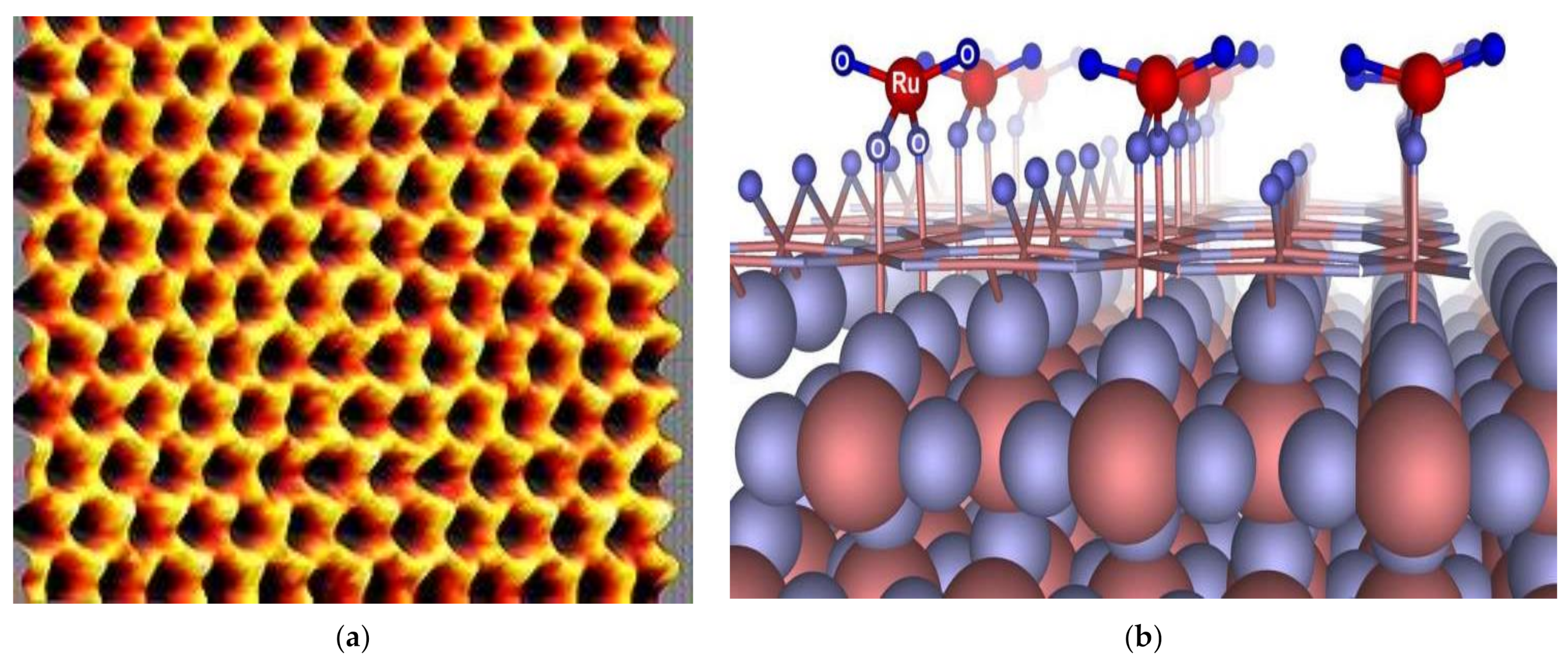
SC electrodes are generally thin sheets that are electrically connected to a conductive current collector. The environmentally friendly and low-cost electrodes must have good conductivity, low corrosion resistance, and long-time chemical stability [9,106]. The different types of carbon electrode materials commonly used in SCs include activated carbon (AC), carbon aerogel, graphene, graphite, and carbon nanotubes (CNTs) [32,33,34,35]. Activated carbon is enough for SC EDLC electrodes, although its electrical conductivity is much lower than metals. One of the most used electrode materials for SCs is a solid form activated carbon called consolidated amorphous carbon (CAC) [23,33]. Activated carbon fibres (ACF) have a diameter of about 10 µm and are derived from activated carbon [118]. Carbide derived carbon (CDC) is a family of tuneable and nanoporous carbon materials [119,120]. The other most widely used materials are random porous carbons, due to their advantages [121]. Graphene atoms, also called nanocomposite paper atoms, are arranged in a regular hexagonal pattern as seen in Figure 5a [122,123,124,125]. MnO2 and RuO2 electrode materials are also used for pseudocapacitors since they act as capacitive electrodes and exhibit Faradaic behaviour, as seen in Figure 5b. Pseudocapacitors occur within the active electrode materials created through Faradaic redox reactions and provide a high specific energy. All the commercial hybrid SCs are asymmetric, and they integrate an electrode [106,126].
Figure 5. (a) Scanning probe microscopy image of graphene, (b) pseudocapacitance surface of RuO2 cathode [126].
Although most of the studies are focused on electrode materials of electrolytes, there are also significant studies on SC performance. The electrolyte consists of a solvent and dissolved chemicals that makes it electrically conductive and increases the quantity of ions in the electrolyte [9,106]. Electrolytes influence the operational voltage window of cells and their resistance [114]. Aqueous, organic, and ionic liquid electrolytes are currently available for SCs [94]. The electrolyte determines the SC’s operating characteristics [127]. Water is a perfect solvent for inorganic chemicals and aqueous electrolytes. Aqueous electrolytes are used in SCs with high specific power and low specific energy density, which have a 1.15 V dissociation voltage per electrode [106,128]. Electrolytes with organic solvents have a higher separation voltage and a temperature range; however, they are more expensive [106,128,129]. Ionic electrolytes consist of liquid salts, and they enable capacitor voltages above 3.5 V s. In addition, they have lower ionic conductivity than the other electrolytes [40].
Although much progress has been made in improving the electrode performance, in SCs, separators can negatively influence the performance of SCs to depend on the poorly designed dividers [9]. The separator can be very thin and must be very porous to minimise ESR. Developed polymer-based separators with low cost, high flexibility, and porosity lead the separator markets [41,94,106,130]. The majority of energy storage devices require collectors to connect the capacitor electrodes and supplement the performance of SCs, because of the active material’s insufficient conductivity. Additionally, they must carry high charge and discharge currents [94,106,131]. Sealing in cell mounting is very important to prevent performance loss in the SC. Aluminium metal should be used in collectors to prevent a corrosive galvanic cell housing [9,106]. A sealant material’s duty is to prevent foreign contaminants from entering the cell that can cause electrolyte disruption, surface oxidation, and the loss of life cycle [94].

3. Techno-Economic Analyses of Supercapacitors

As the use of SCs in the energy and transportation sectors has increased, the cycle life, performance reliability, and cost have become important parameters [10]. The traditional applications of SCs are in short-term power for global system for mobile (GSM) communication bursts and high brightness flashes in cell phones, hybrid battery–SC systems for uninterruptable power supplies (UPSs) and power-quality enhancers, automotive systems for integrated starter generator applications, power tools, and extra high-power short-autonomy-time UPS systems without batteries [31]. After a stable period, the SC market has now entered into a continuous period of vigorous growth. Three large companies’ last actions have triggered this. According to a report; “Supercapacitor: Applications, Players, Markets 2020–2040”, it is foreseen that a yearly additional SC market of over 0.5 billion USD will emerge in 2030 if only a few per cent of 48 V mild hybrids adopt SC peak shaving in ten years [79]. This foresight indicates the need to explore the SC techno-economy in detail. The advantages and disadvantages of SC, the market structure, product analyses and evaluation, new manufacturing technologies, and manufacturing corporations are investigated in this section in more detail.
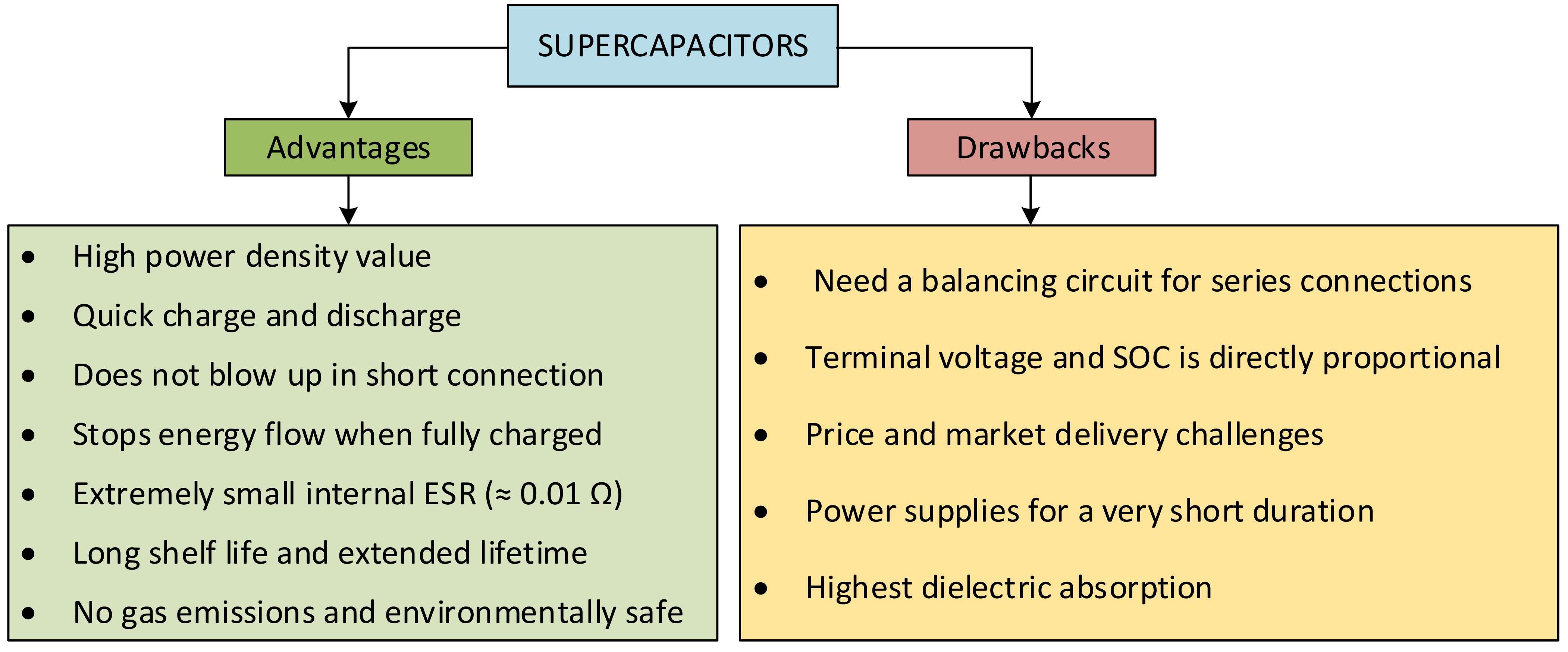
The main advantages and drawbacks of SCs are compared in Figure 6 [14]. Although they have some drawbacks, the benefits of SCs give them superiority over the other storage devices in many ways. Comparing the advantages and disadvantages, using them in some applications with the other storage devices seems reasonable [3,12].
Figure 6. The main advantages and drawbacks of SCs.
The comparison of the advantages and drawbacks of lead-acid, lithium-ion, redox-flow batteries, and SCs is shown in Table 1. Although the specific energy density is greater for lithium-ion batteries, specific power density is greater for SCs, at a value more than ten times the others. The cycle life is also very high for SCs; however, the charge and discharge efficiency is better for lithium-ion batteries. The SC charge and discharge time is under one minute. The calendar life is about 20 years for SC, and the costs are lower than the lithium-ion batteries and decrease with every passing day [3,12,42,44,45]. Although the iron-based flow batteries have a long life and are environmentally friendly, they have a lower energy and power density [8,132].
Table 1. Comparison of SCs with different types of batteries [3,12,132].
The top global EDLC manufacturers, start-ups, and companies are summarised in Table 2 with their centred country, estimated financings for start-ups, and revenue data. Revenue is based on fourth-quarter reported values and was converted to US dollars [133].
Table 2. Top 12 SC manufacturers in the world and their primary information [133].
SC devices from these manufacturers have capacitances in the range of 1200–5000 F, shallow direct current (DC) equivalent series resistance (ESR) values of less than one mΩ, short circuit current in the field of 600–2400 A, and per cell energy-storage capabilities in the range of 0.6–3 Wh. Table 3 indicates some representative devices.
Table 3. A comparison of single-cell SCs for fast energy delivery applications [31].
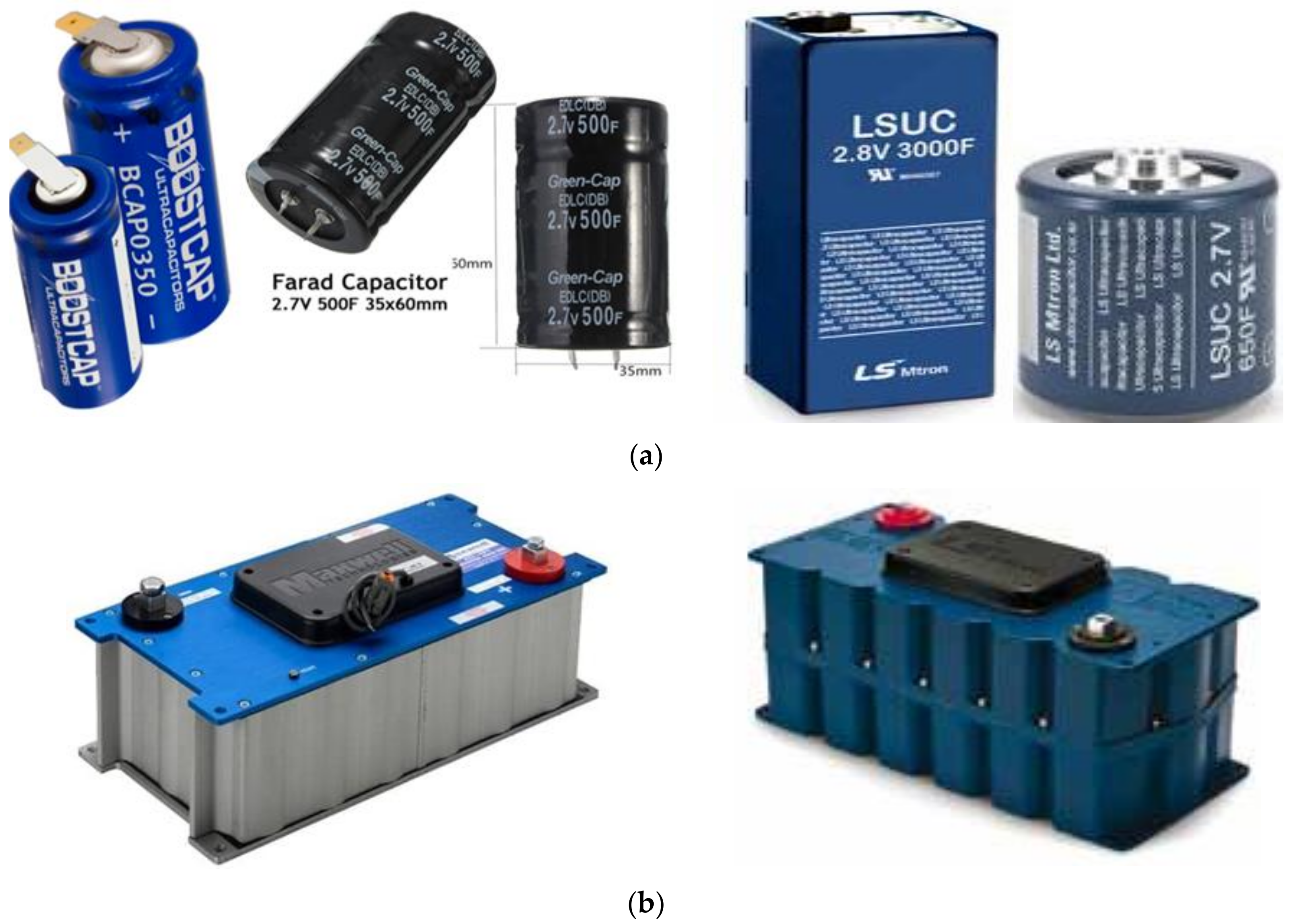
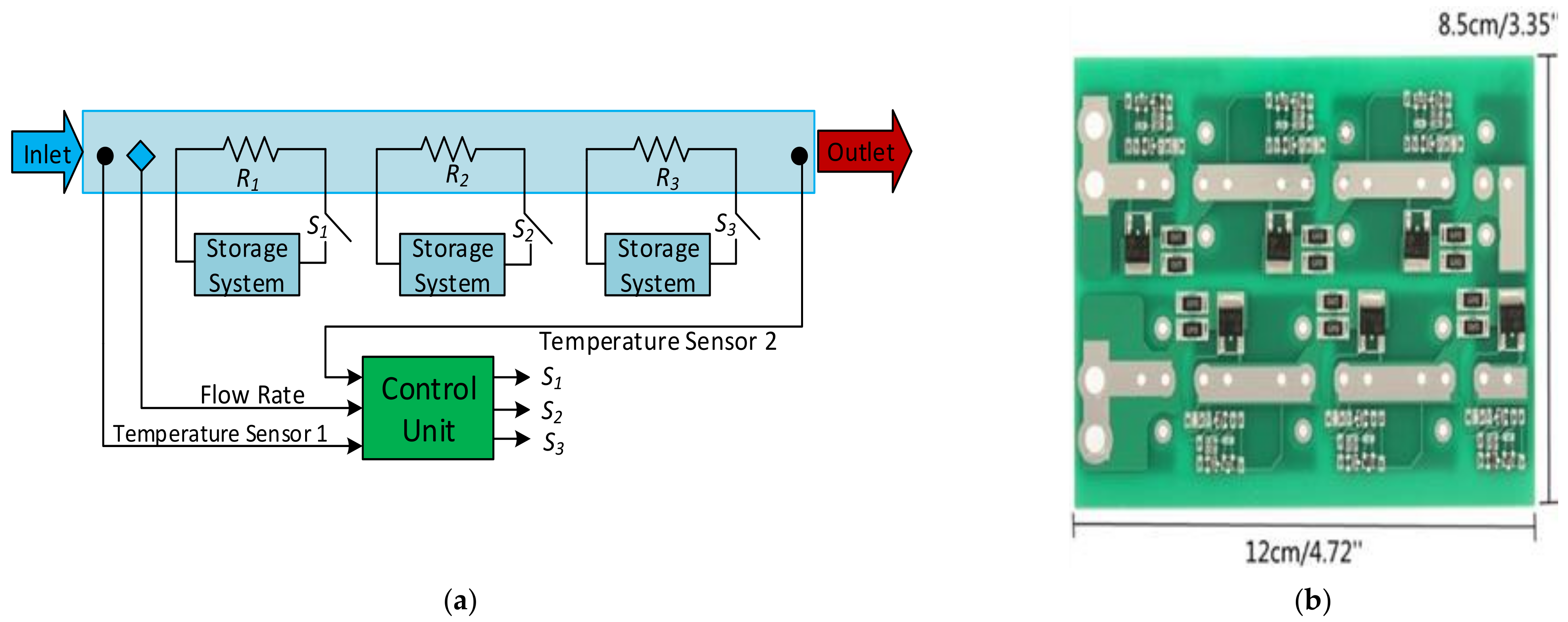
Some of the different commercial SC devices and their dimensions are given in Figure 7a. Their rated voltage can be 2.7–2.8 V, as mentioned in Table 3. They can be produced as a cylindrical or prismatic type cell. The Maxwell Technologies and LS Mtron Corporations offer different voltage module SCs with a high cycle life and 48 V DC working voltage, as shown in Figure 7b. Temperature output, active cell balancing, and high power density are the main features of these modules. The SC modules are designed to provide cost-effective construction equipment and hybrid bus solutions, specifically. They are also widely utilised in telecommunications, power supply, and other applications [59,102,134]. They are a reliable solution for these sensitive works and consumers; however, they are an expensive solution for the widespread use of SCs in energy storage. The details of the module design specifications are investigated in more detail in the last section.
Figure 7. (a) Different types of SC commercial devices, (b) two different corporations’ SC modules.

4. Applications of SC

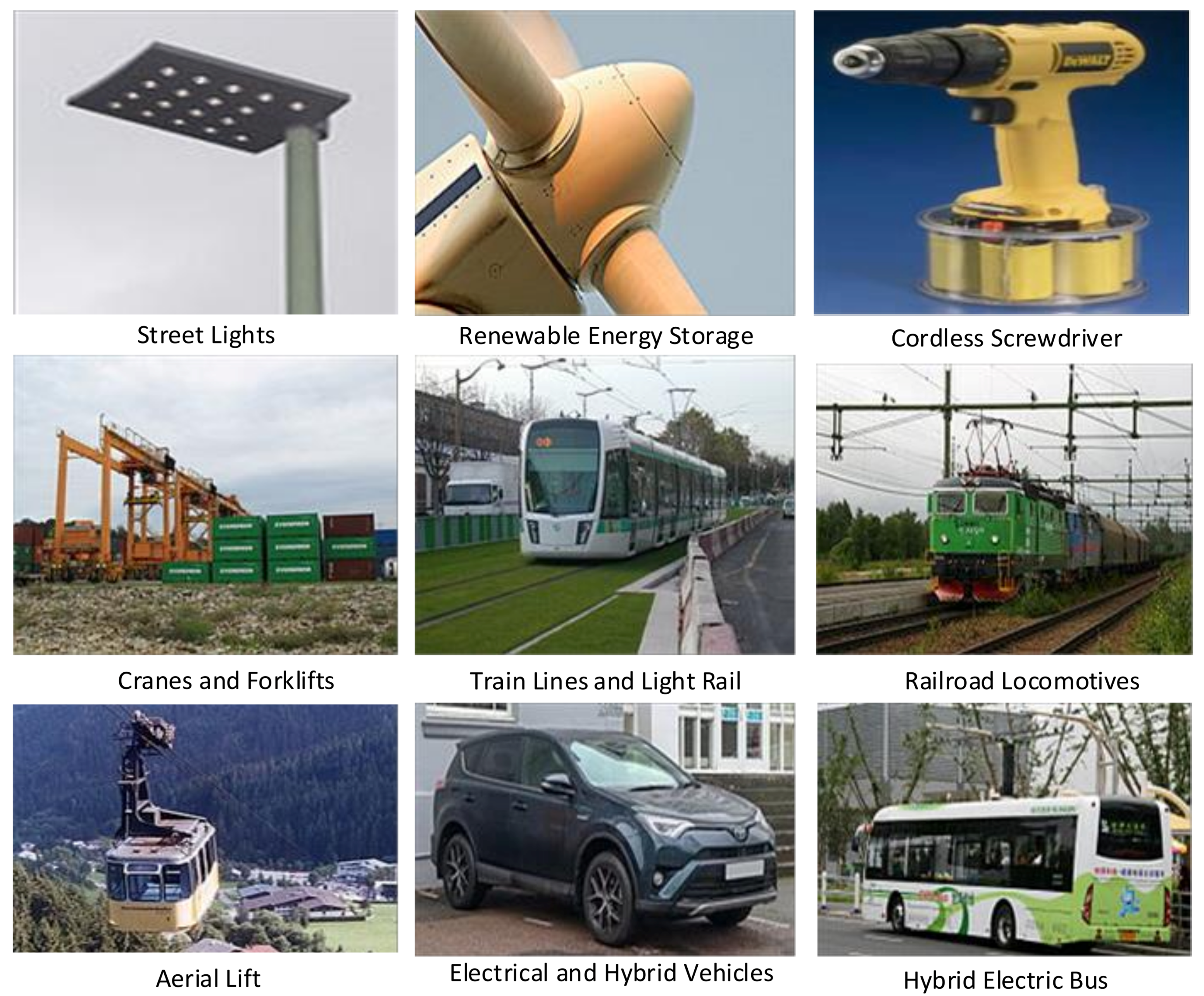
The SC has many advantages in applications with a high power density, and many charge/discharge cycles or a longer life are required. SCs are used in wind turbines, mobile base stations, electronic devices, and different industrial practices [135,136,137]. In addition, they have started to be used in UPS, electric vehicles, and various power electronics applications, thanks to their superiority over lead-acid batteries [138,139,140,141]. In recent years, SCs have been used as an energy storage device for voltage stability in renewable and hybrid energy storage systems to regulate the source and grid [3,10,141]. SCs can stabilise the power supply in applications with fluctuating loads [142]. SCs deliver power for flashes, which can be charged quickly [62,143], and portable speakers [144]. Reducing energy consumption and CO2 emissions is a primary difficulty of all transportation systems, and braking energy recovery can reduce both. Many applications in all kinds of vehicles require elements that can rapidly store and deliver energy, and SCs fulfil these requirements. Some SC applications include consumer electronics [62,63], tools, power supply [64], voltage stabilisation [65], microgrid [66], renewable energy storage [3], energy harvesting [67,68], street lights [69], medical applications [70], military and automotive applications [71,72,73], and energy recovery [74,75,76,77]. Some of these examples are given in Figure 8.
Figure 8. Some examples of SC applications.
Multiple variable loads, such as hybrid electrical vehicles (HEVs), electrical vehicle (EV) charge stations, electrical machines, and other power systems, cause current fluctuations and harmonics and power oscillations on the grid [63,64]. SCs can be used between the load and the grid as an interface to overcome these problems [145]. One wireless screwdriver with SCs is charged fully in 90 s, and it can retain 85% of its charged energy after three months left idle [146]. The backup power for actuators in wind turbine pitch systems is also provided by SCs [144]. Photovoltaic and wind energy systems act as a fluctuating supply induced by weather conditions. SCs can stabilise such as voltage fluctuations for power lines by acting as dampeners [66]. SCs can be used for microgrid storage, usually powered by renewable energy which cannot instantaneously match the demand to inject power when the demand increases and the production decreases temporarily [68,147]. SCs are suitable energy harvesting systems for temporary energy storage devices [3]. For example, in Japan’s Niigata Prefecture, Sado City, there are streetlights that combine stand-alone SCs with s power source for storage [69].
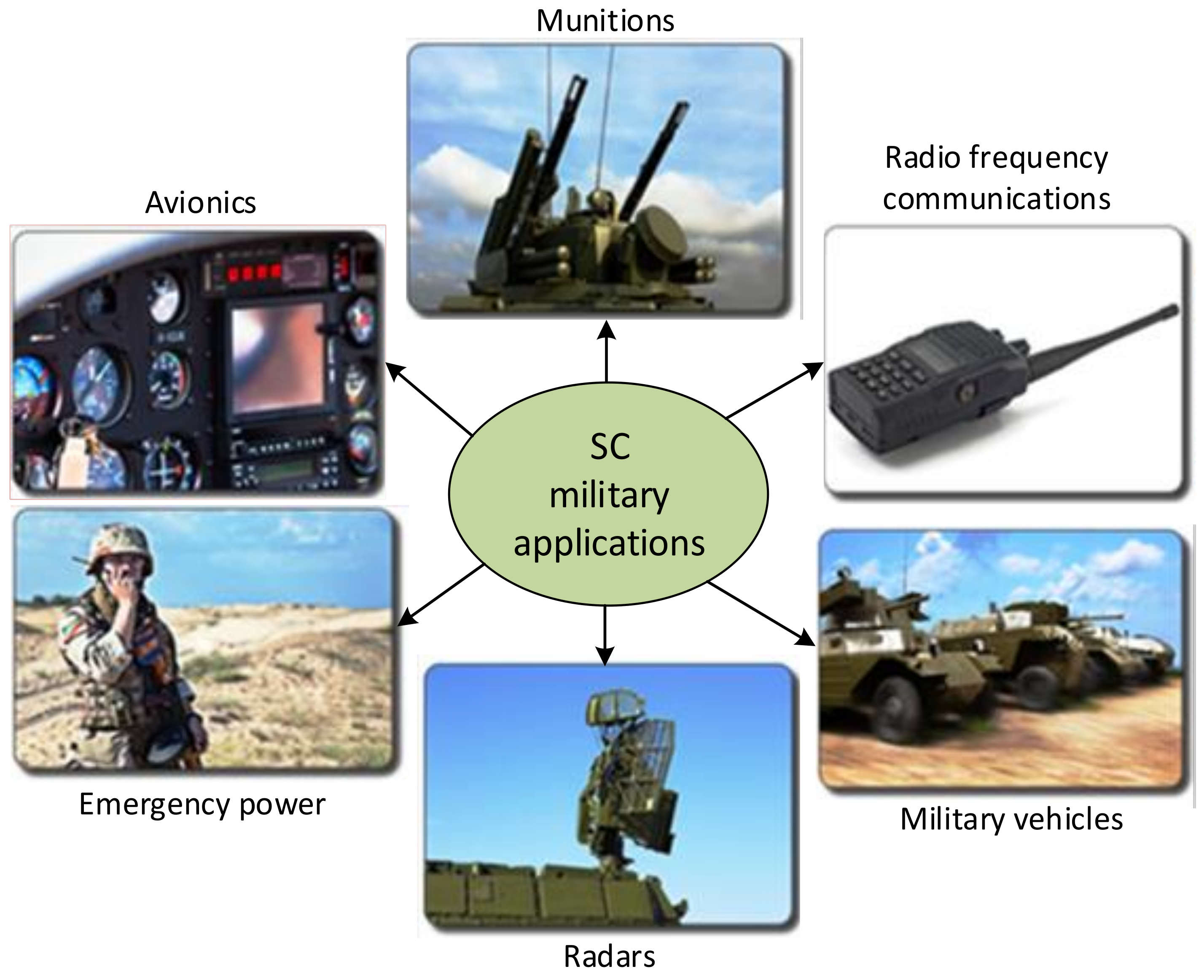
Hybrid SCs are also implemented in navigators, sensors, and communication devices based on batteries. The radar system, electromagnetic pulse weapons, torpedoes, etc., can also be operated using a suitable installation of hybrid SCs [148]. Many SC systems for military applications are manufactured by the Tecate Group corporation, as shown in Figure 9 [148]. The radar antenna, airbag exploitation power, avionics, GPS, and missiles are applications that require a high specific power [28].
Figure 9. SCs used for different defence applications.
SCs also fulfil the requirements for some transportation applications, which are given here. Toyota’s Yaris hybrid-R concept car and Peugeot Société Anonymes (PSAs) Peugeot Citroën both use an SC to increase the performance of the vehicles [149]. The Maxwell Technologies manufacturer corporation claimed that several hybrid buses use SC devices to improve acceleration [149]. Batteries can be supplemented with SCs in the starter systems of diesel railroad locomotives with hybrid transmissions [71]. Mobile hybrid rubber tyre gantry cranes use SCs to move stack containers [70]. One hybrid forklift primarily uses fuel cells and batteries, while SCs store the braking energy of buffer power peaks. In 2003, a light-rail vehicle prototype was developed with a roof-mounted SC unit to save braking energy and replace overhead lines in Mannheim [72]. The Paris T3 tram line and Geneva Public Transport tram were powered using SCs to recover the energy during braking in 2012 [150].
The first hybrid bus in Europa with SCs was the so-called “Ultracap Bus” tested in Nuremberg, Germany, in 2001. Then, an electric bus fleet was tested in Luzern, Switzerland, in 2002. After every transportation cycle, the SCs could be recharged within 3 to 4 min with a high-speed power charger [151]. A new type of electric bus using SCs, called the “Capabus”, that moves without power lines and fully charges at the last terminal was tested in Shanghai in 2005 [75]. A Toyota hybrid racing car used a hybrid drivetrain with SCs that was developed every year [152]. More researchers have explored hybrid electric vehicles (HEVs) [153,154]. The ability of SCs to charge much faster than batteries, their longer lifetime, stable electrical properties, and wide temperature range make them suitable for electric vehicles. However, SCs’ lower specific energy density makes them unsuitable for long-distance driving as a stand-alone energy source [77]. As of 2013, all EV or HEV automotive manufacturers have developed prototypes to improve driveline efficiency and store braking energy that use SCs instead of batteries [152,155]. Today’s HEV technology has used SCs to develop more topologies using power electronics converters to increase the efficiency of EVs, improve the environmental perspective, and lower cost. [156,157].
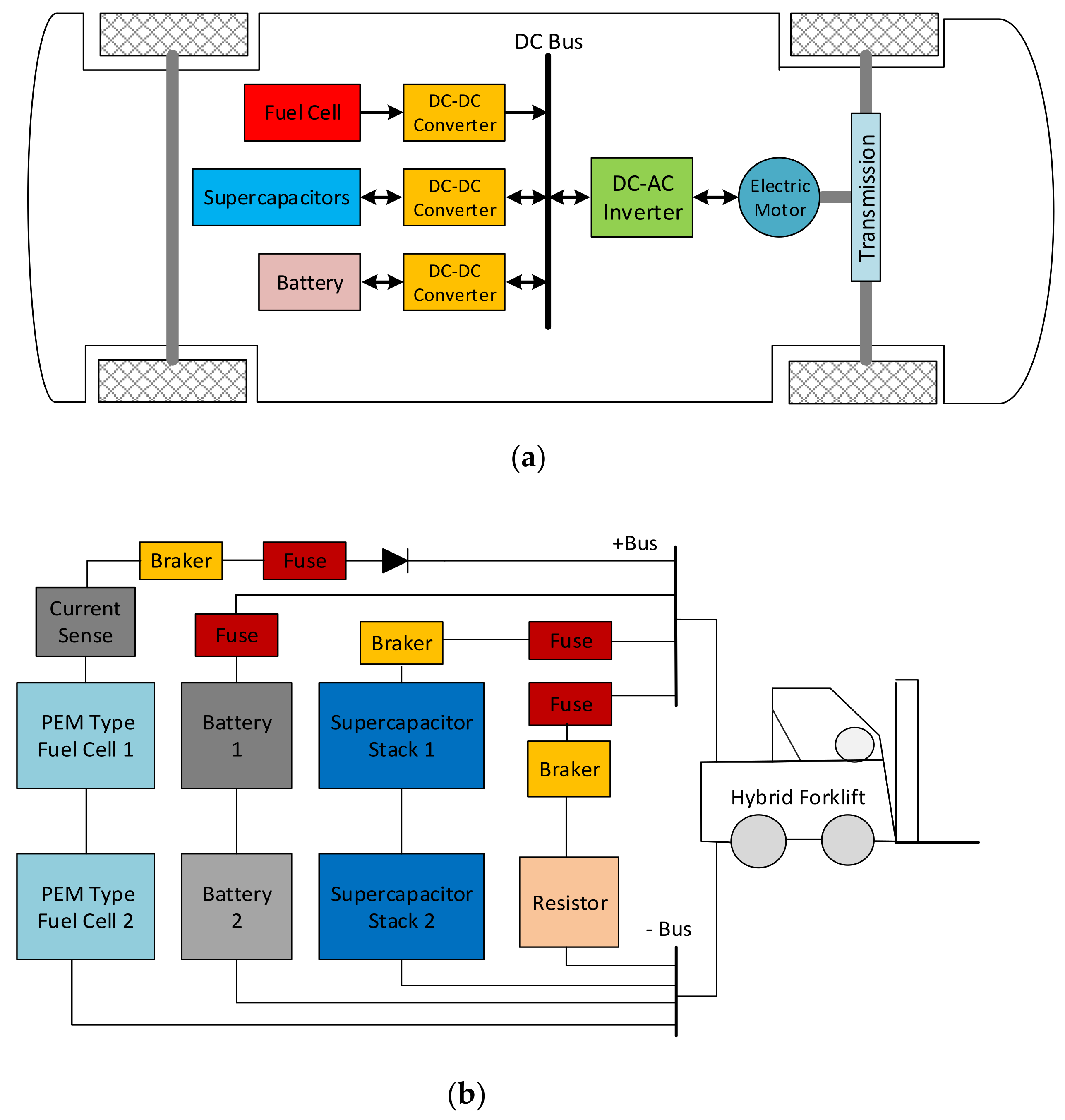
An HEV uses different energy sources, including batteries, SCs, and fuel cells (FCs), to power the electric drive system, as seen in Figure 10a. A fraction of the energy exchange capability of the SC can be used in a battery/SC configuration only. Therefore, a hybrid fuel cell/battery/SC configuration still provides the most extended lifetime of the batteries [158,159]. As a solution, a forklift truck project was carried out with a 16 kW power hybrid system, as shown in Figure 10b. An ‘Integrated Fuel Cell Hybrid Test Platform in Electric Forklift’ designed in the Technical Research Centre of Finland Ltd. (VTT) consisted of an 8 kW power proton exchange membrane (PEM) type fuel cell, which provided 72 kW of power to Maxwell BOOSTCAP® (165F, 48 V) SCs and 300 Ah lead-acid batteries [160,161]. Another study reviewed energy systems for light-duty vehicles, and highlighted the main characteristics of electric and hybrid cars based on power train structure. Different topologies and energy management strategies for electric and hybrid vehicle powertrains have been investigated [162,163].
Figure 10. (a) A basic HEV drive system. (b) Hybrid forklift power source DC schema with two SC modules [160].
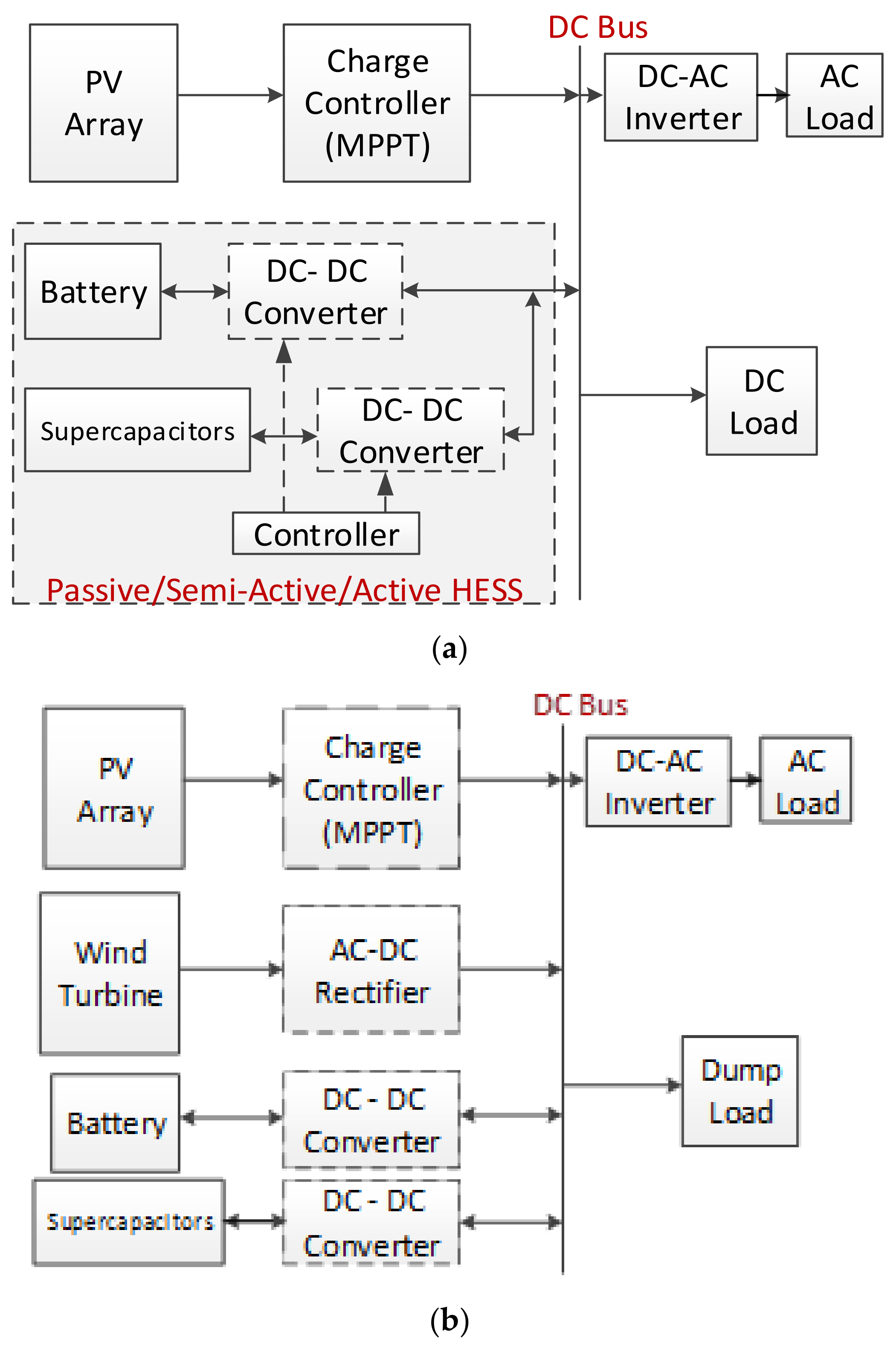
The comparison of SCs with the other energy storage devices has been investigated for PV–battery–SC systems in the literature, and has been shown that SCs have some advantages [14,42,43,46,47,48]. In addition, PV–battery–SCs or fuel cell combinations as HESSs are suggested as an alternative solution [49,50]. The HESS topologies include passive, active, and semi-active types. A passive HESS consists of the different energy storage devices connected directly to the DC bus without a DC–DC converter. If one side is combined with a DC–DC converter to a DC bus, it is called a semi-active HESS. If two sides of the energy storage devices are connected with converters, it is called an active HESS. The connection topology of HESSs is given in Figure 11a [3,12,43]. The active and passive HESSs were simulated and compared in a case study. While the SC semi-active HESSs performed with lower than 33% battery life, passive HESSs performed with lower than 9% battery life, only in the case of price function results during a day [3,12,43]. In another study, solar irradiance and temperature data were used for a solar farm model in MATLAB/Simulink from four diverse days from the 2017 simulation to define the annual storage cost, and the results showed that the battery + SC HESS cost was 25% cheaper annually [51]. In another study, a passive HESS was proposed for a wind and solar energy stand-alone system and the operation was tested via theoretical simulation and experimentally. The HESS (battery–supercapacitor) for the wind and solar energy-fed basic structure is shown in Figure 11b [164].
Figure 11. (a) A stand-alone active HESS with SC. (b) A HESS for a wind-solar fed system.
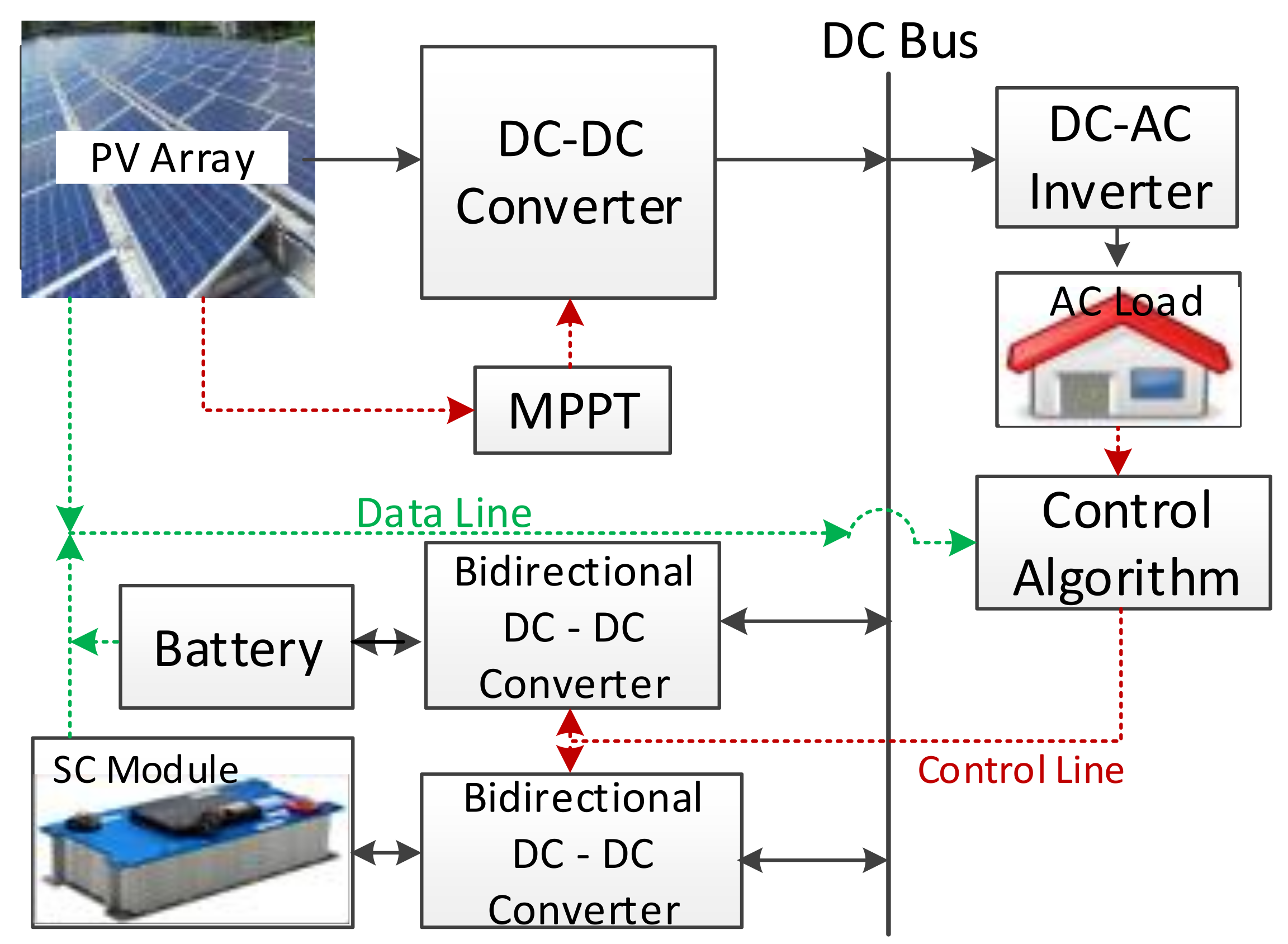
Several studies have presented comprehensive reviews of HESS control strategies for power quality improvement in microgrids in the last decade [132]. The increasing use of renewable energy sources and the interruption of the power generated has caused stability, reliability, and power quality problems in the primary electrical grid [165]. The microgrid is very sensitive to load or generation changes, as it is a weak electrical grid, and HESSs are used to decrease the effect of these variations [166]. Battery–supercapacitor HESSs in stand-alone DC microgrids have been reviewed, and a stand-alone photovoltaic-based microgrid with an HESS was presented as a case study [12]. A survey of a battery–supercapacitor HESS for a stand-alone PV power system in rural electrification was presented in a study [167]. A design and performance analysis of a stand-alone PV system with an HESS is given in another survey for a rural area of India. Bidirectional DC to DC converters are also used in controlling, with a fuzzy logic controller as a new control algorithm, as shown in Figure 12 [168].
Figure 12. A sample PV-HESS microgrid system structure for domestic application [168].

5. Modelling and Performance Tests for SCs

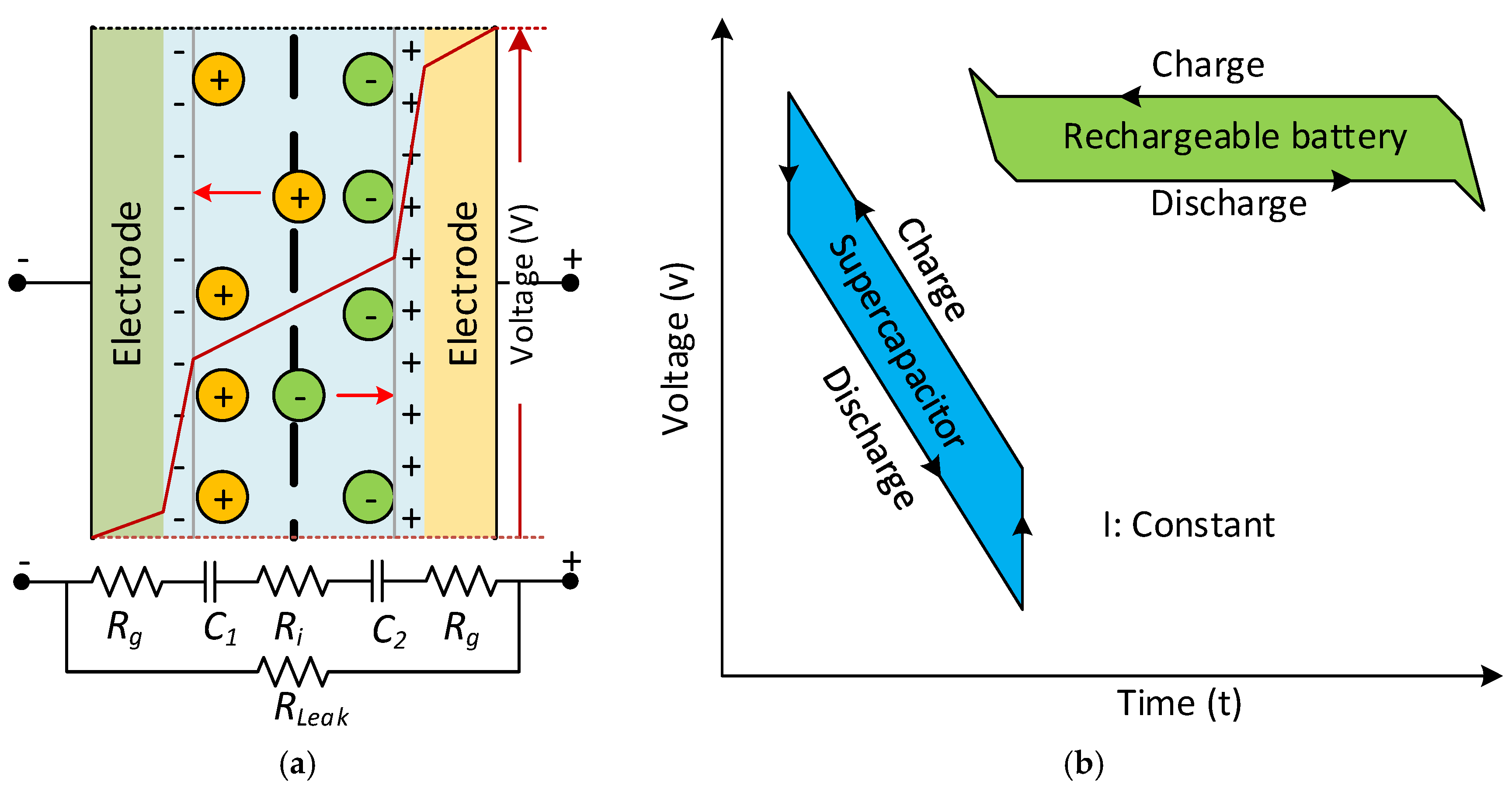
The applied voltage to the poles is linearly proportional to the amount of electric charge stored in an SC, which has units of Farads. The voltage distribution among the SC and its simplified equivalent DC circuit model is seen in Figure 13a, as a functionality illustration of an SC. The electrode’s equivalent circuit depends on the porous structure’s capacitance behaviour, and is defined with series and parallel connected RC elements. The voltage behaviour of SCs and batteries differs during charge and discharge intervals, as seen in Figure 13b. The energy is stored in a static electric field in conventional capacitors consisting of two electrodes. The total power increases linearly related to the potential between the plates and the accumulated charges. In contrast, SCs consists of two electrodes separated by a separator and the energy stored inside the double layers of both electrodes. The storage of electrostatic and electrochemical energy in SCs is linear concerning the stored energy charge similarly [106].
Figure 13. (a) The voltage distribution among the SC between simplified equivalent DC circuits. (b) Comparison of SC and battery voltage behaviour during the charge and discharge time.
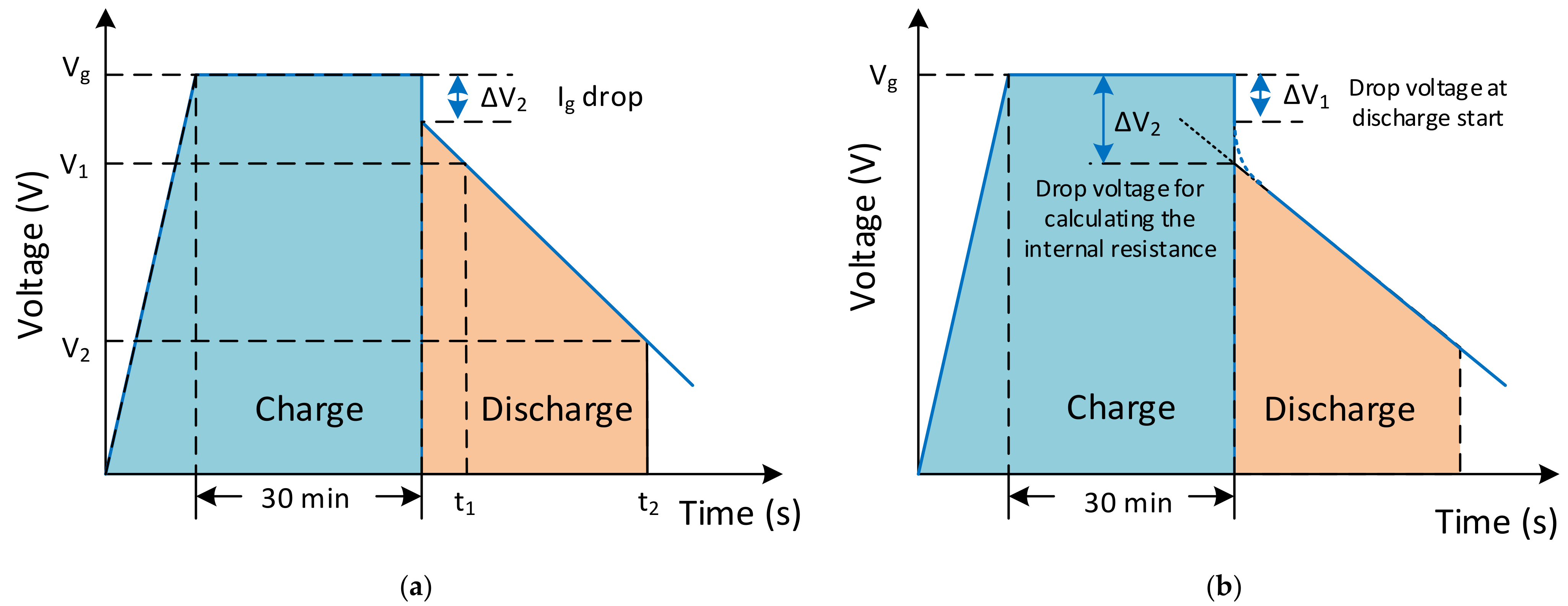
The SC modelling and charge–discharge characteristics must be investigated differently from conventional storage devices. The capacitance value of an SC can be defined with RC components and time constants, depending on the frequency. The measurement characteristic for measuring capacitance is shown in Figure 14a. The rated voltage has to be applied to charge the capacitor for measurement firstly, and the SC is charged for 30 min. Next, the SC is discharged with a constant discharge current (Idischarge) [169]. Then, for the voltage drop from 80% (V1) to 40% (V2) of the rated voltage at the t1 and t2 time values is measured, and the capacitance value of the SC is calculated from this Equation (ج=أناΔتΔالخامس) [106,170]. The internal DC resistance (Ri) of an SC can be calculated with the voltage drop (ΔV2) obtained from the intersection of the auxiliary line extended from the straight part and from the time base at the time of discharge start, as shown in Figure 14b [29,169].
Figure 14. The charge–discharge characteristics for (a) measuring the capacitance and (b) internal DC resistance measurement conditions.
For SC systems, modelling is necessary for system dimension monitoring conditions. Chemical, mathematical, and electrical characteristics, ageing, artificial intelligence, and the dynamic structure of SC models are available in the literature [80,81,82,83,84,85,86,90]. To describe the behaviour of SCs, a simple electrical model of SCs has also been given in the literature [91]. The module simulation was based on a two-branched SC circuit model [89,90,91,92]. This circuit was simplified for the SC module and is given in Equation (4). The SC module voltage and currents are USC and ISC, and the primary voltage and currents are vsc and isc, respectively [89].
يوسج=نس_سجالخامسسج=نس_سج(الخامس1+ر1.أناسج)=نس_سج(الخامس1+ر1أناسجنص_سج)
Moreover, it considered the equivalent electric circuit with two RC branches proposed by Zubieta and Bonert [90] and Rafik et al. [91]. The calculation used to obtain the relationship between voltage (v1) and capacitor charge (Q1) is seen in Equation (5), and can be combined with Equation (4) as in Equation (6).
الخامس1=-ج0+ج02+2جالخامسس1جالخامس
يوسج=نس_سجالخامسسج=نس_سج(الخامس1+ر1.أناسج)=نس_سج(-ج0+ج02+2جالخامسس1جالخامس+ر1أناسجنص_سج)
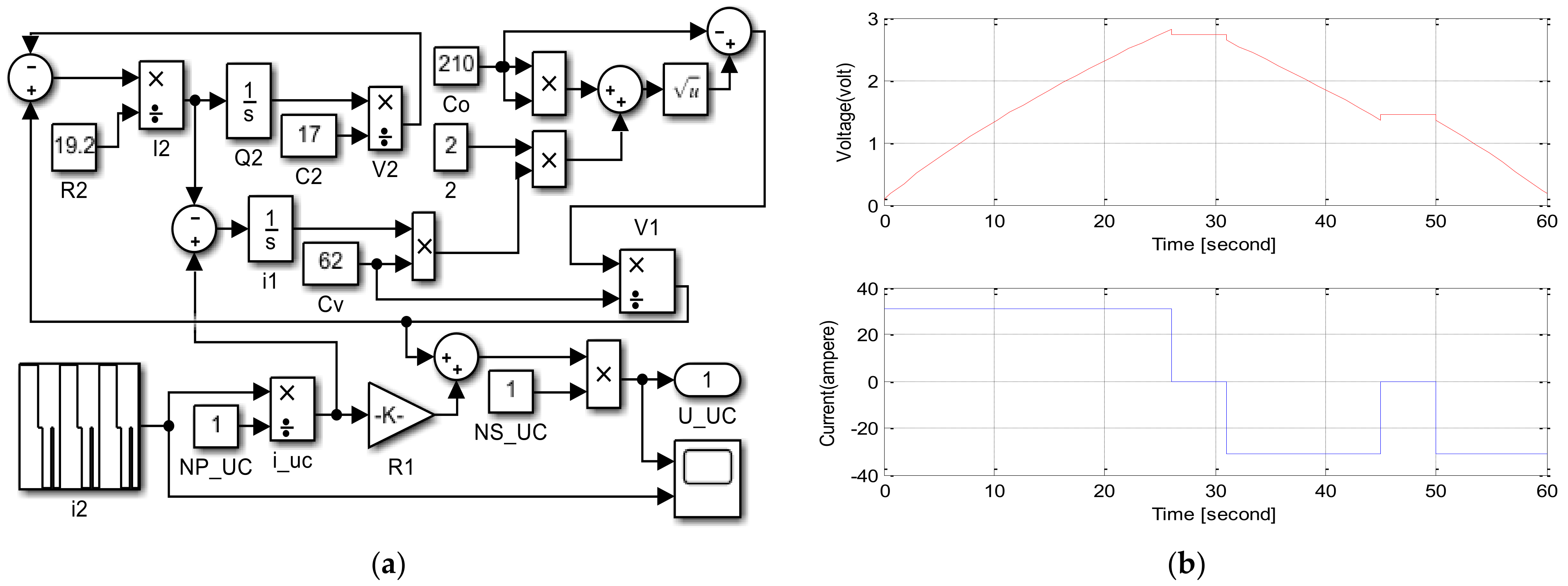
An SC module model was designed in MATLAB/Simulink using these equations, as seen in Figure 15a. Equations (5) and (6) were revised for 310 F SC parameters obtained and calculated in experimental result values and datasheets from previous studies in the simulation [52]. The SC model was simulated for cycle life, and Capacitor ESR measurement waveforms in the datasheet were checked; the results are presented in Figure 15b [102,169].
Figure 15. (a) SC module model in MATLAB/Simulink. (b) CAP/ESR waveforms of SC [169].
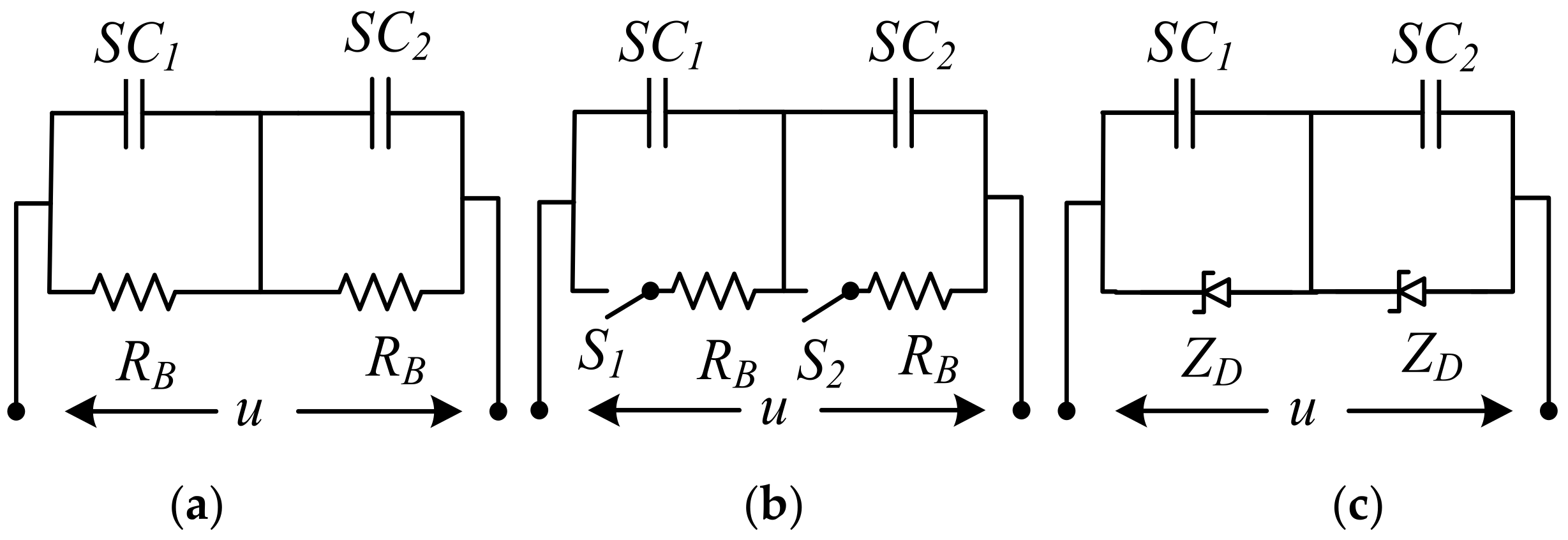
Higher source voltages are required when connecting SCs in series. Each component has a slight difference in capacitance value and ESR. Therefore, it is needed to actively or passively balance the SC to balance the applied voltage. Although passive balancing in SCs is supplied with parallel resistors, active balancing includes electronic voltage management that varies the current above a threshold. Active techniques have many advantages over passive methods. In contrast, passive strategies are straightforward, and despite their shortcomings, they are still prevalent, as shown in Figure 16 [171]. However, passive balancing with resistors improves voltage distribution in SCs, because extra currents passing through balancing resistors reduces the energy efficiency of SCs in their application as energy storage devices. The use of circuits has been proposed for active voltage balancing in SCs [61]. Although the load current and cycle stability of SCs are higher than that of rechargeable batteries, the SC life and the number of cycles increase with the lower load current [165].
Figure 16. SC voltage balance (a) resistor, (b) switched resistor, (c) Zener diode circuits.
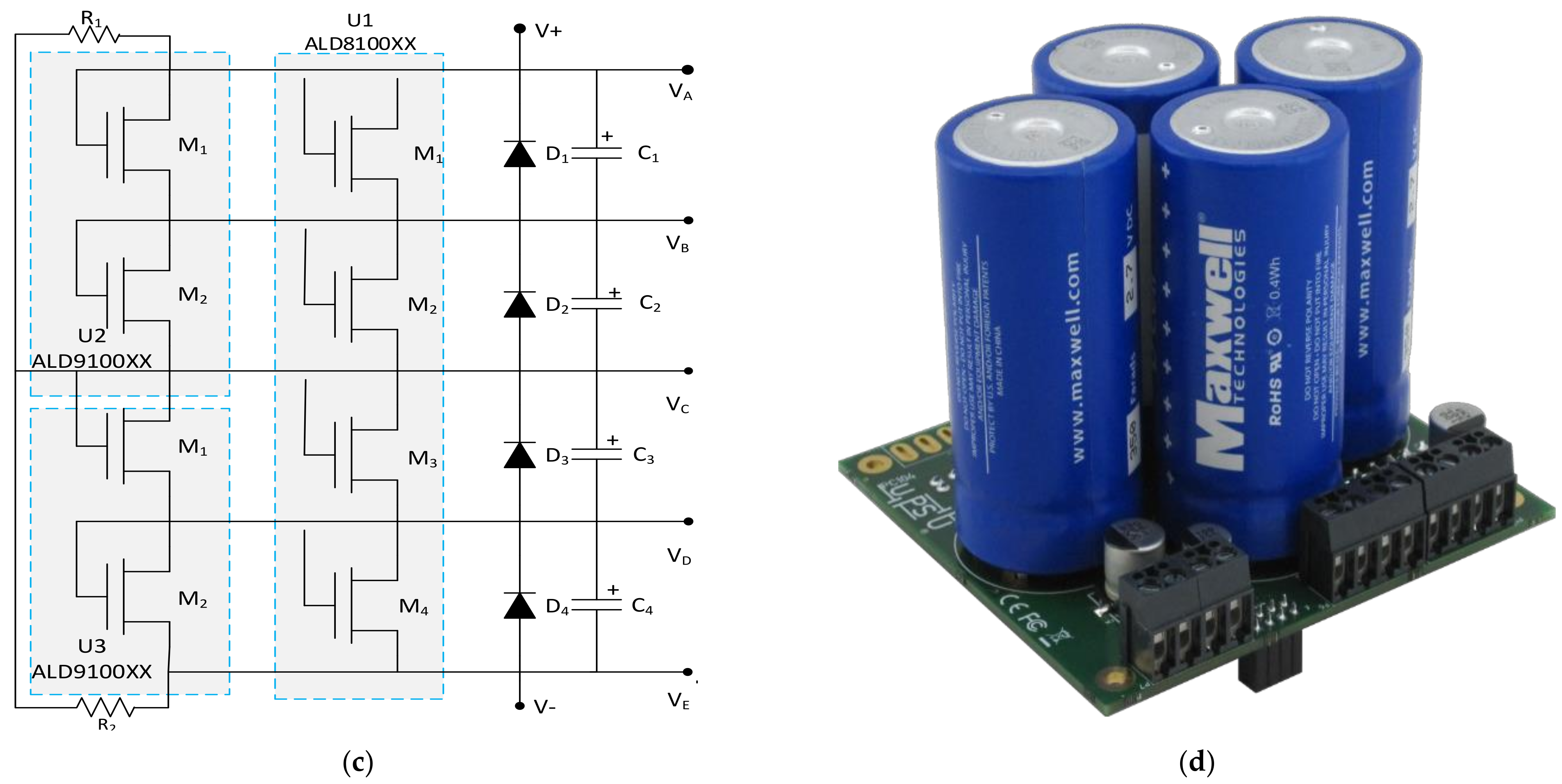
It is possible to find some products on the market for special rates and offers, and the customers can mount them to reduce the prices. An active voltage balancing SC-assisted surge absorber (SCASA) was developed using a recently patented technique [172]. This patent-pending technique uses an SC-assisted temperature modification apparatus (SCATMA), as shown in Figure 17a. This technique is based on the availability of large EDLC devices with capacitances in the range of 1200–5000 F, shallow ESR values, short circuit current capability in the field of 600–2400 A, and per cell energy storage capabilities in the capacity of 0.6–3 Wh [30]. A six-string supercapacitor protection board used for the module design is shown in Figure 17b [173]. A circuit diagram of the protection board for four capacitors’ balanced storage is shown in Figure 17c. Each SC can have a single metal oxide semiconductor field effect transistor (MOSFET) or two devices in parallel, connected depending on the selected board. An equivalent MOSFET gives twice the output current and twice the sensitivity to voltage change, connecting two devices in parallel [60]. An example commercial product for the SC module for a modular solution with UPS and advanced technology extended (ATX) power modules is seen in Figure 17d [174].
Figure 17. (a) Implementation of the SCATMA technique. (b) A six-string supercapacitor protection board [173]. (c) A circuit diagram of the protection board [60]. (d) An example commercial product for the SC module [174].

6. Summary of the Literature

The main contributions in the different areas, summarized from the literature, is analysed in this section. A summary of the entire literature review is given in Table 4 in a comparable form for this aim. The main classification and sub-classification with classification details are provided for the references in the table. The general studies mainly included the history, review, and developments of SCs. The energy storage applications are divided into three subgroups as HESSs, EV storage systems, and microgrid applications. The materials studied include the electrode, electrolyte, and the other components. The modelling and characterisation studies are in one other group in the table. The application studies are classified as manufacturer companies and various application studies. The energy storage applications and materials studies are a large portion of these sources.
Table 4. Summary of literature classifications.
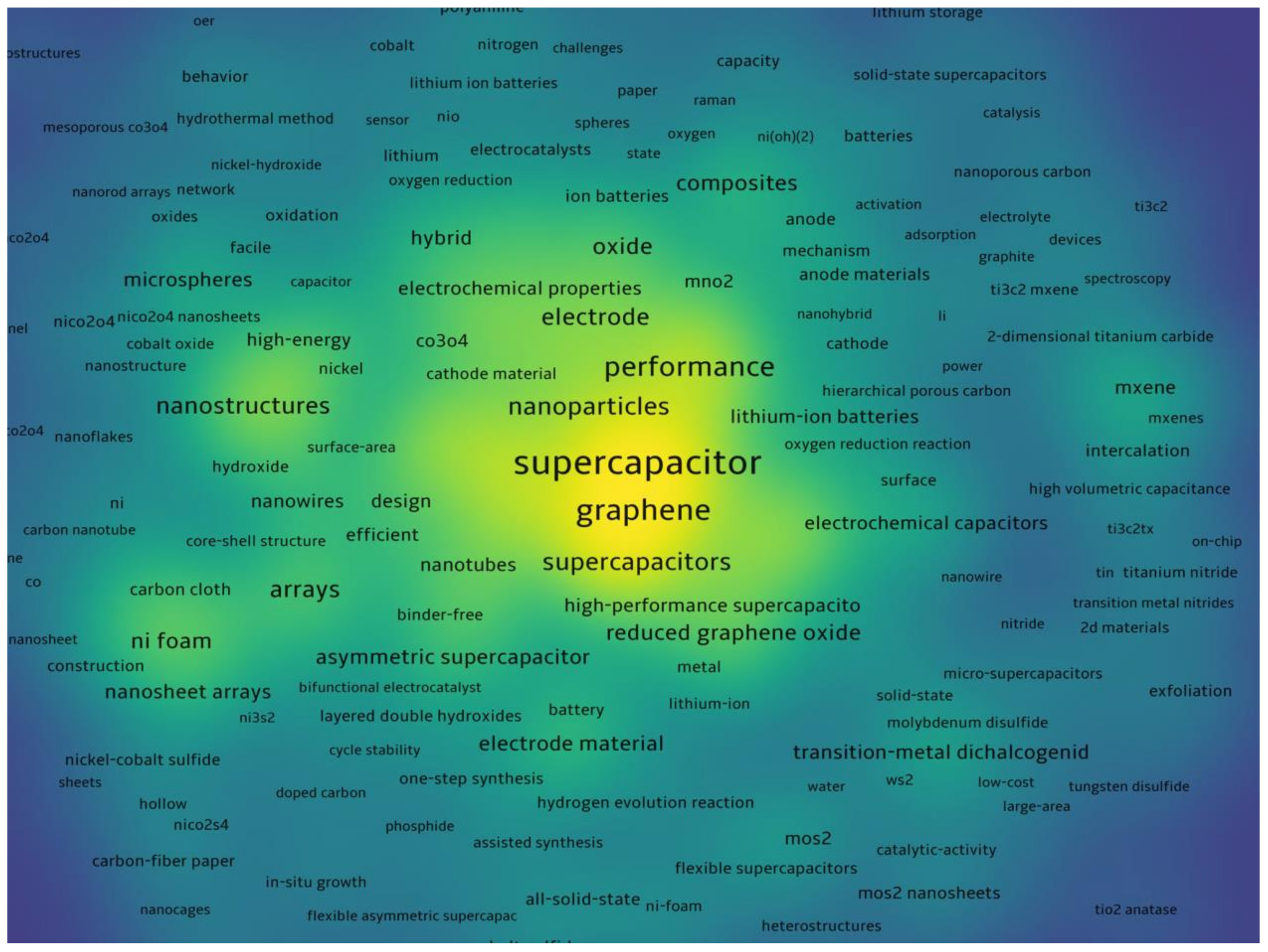
The bibliometric mapping of the SC research field showed 964 results over the last five years. As seen in the density visualization map in Figure 18, derived from the bibliometric results, main keywords dominate the existing research. These include graphene, nanostructure, and Ni foam. Interestingly, composites fall slightly outside the intensive region [19].
Figure 18. Bibliometric density mapping of the SC research field in the last five years.

7. Conclusions

The history and developments of SCs were presented in this paper. The structure, working principles, specifications, classifications, and materials were provided as a fundamental of SCs in this paper in a comparable form. The techno-economic analyses of SCs were investigated in many ways, including advantages, markets, new technologies, and manufacturers. The application of SCs were examined for several applications, such as transportation, electric vehicles, hybrid power systems, and military applications, to shine a light for the readers. This paper investigated and shared the SC modelling, performance tests for charge and discharge, and module design specifications. This comprehensive review paper about SCs combined all the studies in a comparable form to inform and inspire the research studied in this area. At last, this study, which dealt with the latest developments in the literature and the market, will fill a gap in and contribute to the literature. The innovations in material technologies mentioned in this article and overcoming the difficulties in application, becoming more efficient, and becoming more attractive in the market in terms of price seem to be the most critical challenges for the widespread use of SCs.

Author Contributions

Conceptualization, M.E.Ş. and F.B.; Methodology, M.E.Ş.; Validation F.B. and A.S.; investigation, M.E.Ş.; writing—review and editing, M.E.Ş., F.B. and A.S.; supervision, F.B. All authors have read and agreed to the published version of the manuscript.

Funding

This research received no external funding.

Institutional Review Board Statement

Not applicable.

Informed Consent Statement

Not applicable.

Acknowledgments

The authors thank the Scientific & TechnologicalResearch Council of Turkey (TUBITAK), 2219 postdoctoral research program.

Conflicts of Interest

The authors declare no conflict of interest.

References

  1. Novas, N.; Alcayde, A.; Robalo, I.; Manzano-Agugliaro, F.; Montoya, F.G. Energies and Its Worldwide Research. Energies 2020, 13, 6700. [Google Scholar] [CrossRef]
  2. Smith, S.C.; Sen, P.K.; Kroposki, B. Advancement of energy storage devices and applications in electrical power systems. In Proceedings of the 2008 IEEE Power and Energy Society General Meeting-Conversion and Delivery of Electrical Energy in the 21st Century, Pittsburgh, PA, USA, 20–24 July 2008; pp. 1–8. [Google Scholar]
  3. Şahin, M.E.; Blaabjerg, F. A hybrid PV battery/supercapacitor system and a basic active power control proposal in MATLAB/Simulink. Electronics 2020, 9, 129. [Google Scholar] [CrossRef] [Green Version]
  4. Sun, C.; Negro, E.; Vezzù, K.; Pagot, G.; Cavinato, G.; Nale, A.; Bang, Y.H.; Di Noto, V. Hybrid inorganic-organic proton-conducting membranes based on SPEEK doped with WO3 nanoparticles for application in vanadium redox flow batteries. Electrochim. Acta 2019, 309, 311–325. [Google Scholar] [CrossRef]
  5. Yüksek, Ö.; Anılan, T.; Saka, F. Problems and possible solutions to environmental impacts of small hydropower plants in Turkey. Turk. J. Electromech. Energy 2020, 5, 37–47. [Google Scholar]
  6. Şahin, M.E. A photovoltaic powered electrolysis converter system with maximum power point tracking control. Int. J. Hydrog. Energy 2020, 45, 9293–9304. [Google Scholar] [CrossRef]
  7. Zhong, Y.; Xia, X.; Mai, W.; Tu, J.; Fan, H.J. Integration of energy harvesting and electrochemical storage devices. Adv. Mater. Technol. 2017, 2, 1700182. [Google Scholar] [CrossRef]
  8. Zhang, H.; Sun, C. Cost-effective iron-based aqueous redox flow batteries for large-scale energy storage application: A review. J. Power Sources 2021, 493, 229445. [Google Scholar] [CrossRef]
  9. Şahin, M.E.; Blaabjerg, F.; Sangwongwanich, A. A review on supercapacitor materials and developments. Turk. J. Mater. 2020, 5, 10–24. [Google Scholar]
  10. Liu, S.; Wei, L.; Wang, H. Review on the reliability of supercapacitors in energy storage applications. Appl. Energy 2020, 278, 115436. [Google Scholar] [CrossRef]
  11. Omar, N.; Daowd, M.; Bossche, P.V.D.; Hegazy, O.; Smekens, J.; Coosemans, T.; Mierlo, J.V. Rechargeable energy storage systems for plug-in hybrid electric vehicles—Assessment of electrical characteristics. Energies 2012, 5, 2952–2988. [Google Scholar] [CrossRef] [Green Version]
  12. Jing, W.; Lai, C.H.; Wong, W.S.H.; Wong, M.L.D. Battery-supercapacitor hybrid energy storage system in stand-alone DC microgrids: A review. IET Renew. Power Gener. 2017, 11, 461–469. [Google Scholar] [CrossRef]
  13. Sharma, P.; Kumar, V. Current technology of supercapacitors: A review. J. Electron. Mater. 2020, 49, 3520–3532. [Google Scholar] [CrossRef]
  14. Glavin, M.E.; Hurley, W.G. Optimisations of a photovoltaic battery ultracapacitor hybrid energy storage system. Sol. Energy 2012, 86, 3009–3020. [Google Scholar] [CrossRef]
  15. Lindenmaier, J.; Stiegler, M.; Kabza, H. Charge/Discharge Load Reduction of Lead Acid Batteries in Micro-Hybrid Vehicles Using Ultra-Capacitor Assistance. In Proceedings of the 24th World Battery, Hybrid and Fuel Cell Electric Vehicle Symposium, Stavanger, Norway, 13–16 May 2009. [Google Scholar]
  16. Chen, H.; Cong, T.N.; Yang, W.; Tan, W.; Li, Y.; Ding, Y. Progress in Electrical Energy Storage System: A Critical Review. J. Prog. Nat. Sci. 2009, 9, 291–312. [Google Scholar] [CrossRef]
  17. Omar, N.; Verbrugge, B.; Van den Bossche, P.; Van Mierlo, J. Power and life enhancement of battery-electrical double layer capacitor for hybrid electric and charge-depleting plug-in vehicle applications. J. Electrochim. Acta 2010, 55, 7524–7531. [Google Scholar] [CrossRef]
  18. Omar, N.; Van Mulders, F.; Van Mierlo, J.; Van den Bossche, P. Assessment of the behaviour of super capacitor-battery system in heavy hybrid lift truck vehicles. J. Asian Electr. Veh. 2009, 7, 1277–1282. [Google Scholar] [CrossRef]
  19. Maksoud, M.I.A.A.; Fahim, R.A.; Shalan, A.E.; Elkodous, M.A.; Olojede, S.O.; Osman, A.I.; Farrell, C.; Al-Muhtaseb, A.H.; Awed, A.S.; Ashour, A.H.; et al. Advanced materials and technologies for supercapacitors used in energy conversion and storage: A review. Environ. Chem. Lett. 2021, 19, 375–439. [Google Scholar] [CrossRef]
  20. Ho, J.; Jow, R.; Boggs, S. Historical Introduction to Capacitor Technologies. IEEE Electr. Insul. Mag. 2010, 26, 20–25. [Google Scholar] [CrossRef] [Green Version]
  21. Schindall, J.G. The Change of the Ultra-Capacitors. IEEE Spectr. 2007, 44, 42–46. [Google Scholar] [CrossRef]
  22. Boos, D.L. Electrolytic Capacitor Having Carbon Paste Electrodes. U.S. Patent 3536963, 27 January 1970. [Google Scholar]
  23. Namisnyk, A.M. A Survey of Electrochemical Supercapacitor Technology; Technical Report; University of Canterbury: Christchurch, New Zealand, 2003. [Google Scholar]
  24. Evans, D.A. Containers with Anodes and Cathodes with Electrolytes. U.S. Patent 5369547, 29 November 1994. [Google Scholar]
  25. Evans, D.A. The Littlest Big Capacitor—An Evans Hybrid Technical Paper; Evans Capacitor Company: East Providence, RI, USA, 2007. [Google Scholar]
  26. FDK. FDK Corporate Information, FDK History 2000s. Available online: https://www.fdk.com/company_e/ayumi2000-e.html (accessed on 29 October 2021).
  27. Muzaffar, A.; Ahamed, M.B.; Deshmukh, K.; Thirumalai, J. A review on recent advances in hybrid supercapacitors: Design, fabrication and applications. Renew. Sustain. Energy Rev. 2019, 101, 123–145. [Google Scholar] [CrossRef]
  28. Naoi, K.; Simon, P. New Materials and New Configurations for Advanced Electrochemical Capacitors. Electrochem. Soc. Interface 2008, 17, 34–37. [Google Scholar] [CrossRef]
  29. Zhao, J.; Burke, A. Review on supercapacitors: Technologies and performance evaluation. J. Energy Chem. 2021, 59, 276–291. [Google Scholar] [CrossRef]
  30. Kularatna, N. Energy Storage Devices for Electronic Systems: Rechargeable Batteries and Supercapacitors; Academic Press: London, UK, 2015. [Google Scholar]
  31. Kularatna, N. Supercapacitors Improve the Performance of Linear Power-Management Circuits: Unique new design options when capacitance jump from micro-farads to farads with a low equivalent series resistance. IEEE Power Electron. Mag. 2016, 3, 45–59. [Google Scholar] [CrossRef]
  32. Frackowiak, E.; Béguin, F. Carbon materials for the electrochemical storage of energy in capacitors. Carbon 2001, 39, 937–950. [Google Scholar] [CrossRef]
  33. Halper, M.S.; Ellenbogen, J.C. Supercapacitors: A Brief Overview; MITRE Nanosystems Group: McLean, VA, USA, 2006. [Google Scholar]
  34. Pandolfo, A.G.; Hollenkamp, A.F. Carbon properties and their role in supercapacitors. J. Power Sources 2006, 157, 11–27. [Google Scholar] [CrossRef]
  35. Kinoshita, K. Electrochemical Oxygen Technology; Wiley: Hoboken, NJ, USA, 1992; ISBN 978-0-471-57043-1. [Google Scholar]
  36. Brousse, T.; Bélanger, D.J.; Long, W. To Be or Not to Be Pseudocapacitive? J. Electrochem. Soc. 2015, 162, A5185–A5189. [Google Scholar] [CrossRef] [Green Version]
  37. Yuden, T. Coin Type PAS Capacitor; Notice for Products; Shoe Electronics Ltd.: Tokyo, Japan, 2020. [Google Scholar]
  38. Li, X.; Wei, B. Facile synthesis and super capacitive behaviour of SWNT/MnO2 hybrid films. Nano Energy 2012, 1, 479–487. [Google Scholar] [CrossRef]
  39. Naoi, K.; Naoi, W.; Aoyagi, S.; Miyamoto, J.-I.; Kamino, T. New Generation Nanohybrid Supercapacitor. Acc. Chem. Res. 2013, 46, 1075–1083. [Google Scholar] [CrossRef] [PubMed]
  40. Selanne, M. Ionic Liquids for Supercapacitor Applications. Top. Curr. Chem. 2017, 375, 63. [Google Scholar] [CrossRef]
  41. Schneuwly, A.; Gallay, R. Properties, and applications of supercapacitors, From the state-of-the-art to future trends. In Proceedings of the PCIM Conference, Nuremberg, Germany, 7–8 July 2000. [Google Scholar]
  42. Glavin, M.E.; Chan, P.K.; Armstrong, S.; Hurley, W.G. A stand-alone photovoltaic supercapacitor battery hybrid energy storage system. In Proceedings of the Power Electronics and Motion Control Conference (13th EPE-PEMC 2008), Poznan, Poland, 1–3 September 2008; pp. 1688–1695. [Google Scholar]
  43. Jing, W.L.; Lai, C.H.; Wong, W.S.; Wong, M.D. Cost analysis of battery supercapacitor hybrid energy storage system for stand-alone PV systems. In Proceedings of the 4th IET Clean Energy and Technology Conference (CEAT 2016), Kuala Lumpur, Malaysia, 14–15 November 2016. [Google Scholar]
  44. Supercapacitor (EDLC) Basics (Part 1): What Is a Supercapacitor (EDLC)? 2021. Available online: https://www.murata.com/products/emiconfun/capacitor/2015/03/24/20150324-p1 (accessed on 20 October 2021).
  45. Manandhar, U.; Ukil, A.; Beng, G.H.; Tummuru, N.R.; Kollimalla, S.K.; Wang, B.; Chaudhari, K. Energy management and control for grid-connected hybrid energy storage system under different operating modes. IEEE Trans. Smart Grid 2017, 10, 1626–1636. [Google Scholar] [CrossRef]
  46. Khan, M.A.; Zeb, K.; Sathishkumar, P.; Ali, M.U.; Uddin, W.; Hussain, S.; Ishfaq, M.; Khan, I.; Cho, H.-G.; Kim, H.-J. A Novel Supercapacitor/Lithium-Ion Hybrid Energy System with a Fuzzy Logic-Controlled Fast Charging and Intelligent Energy Management System. Electronics 2018, 7, 63. [Google Scholar] [CrossRef] [Green Version]
  47. Shrivastava, A.; Gupta, S. Review on Super Capacitor-Battery based Hybrid Energy Storage System for PV Application. Int. J. Adv. Eng. Manag. Sci. 2017, 3, 239825. [Google Scholar] [CrossRef]
  48. Logerais, P.O.; Riou, O.; Camara, M.A.; Durastanti, J.F. Study of photovoltaic energy storage by supercapacitors through both experimental and modelling approaches. J. Sol. Energy 2013, 2013, 1–9. [Google Scholar] [CrossRef] [Green Version]
  49. Uzunoglu, M.; Alam, M.S. Dynamic modelling, design, and simulation of a combined PEM fuel cell and ultracapacitor system for stand-alone residential applications. IEEE Trans. Energy Convers. 2006, 21, 767–775. [Google Scholar] [CrossRef]
  50. Thounthong, P.; Pierfederici, S.; Martin, J.P.; Hinaje, M.; Davat, B. Modelling and control of fuel cell/supercapacitor hybrid source based on differential flatness control. IEEE Trans. Veh. Technol. 2010, 59, 2700–2710. [Google Scholar] [CrossRef]
  51. Roy, P.K.S. Design of a Cost-Effective Battery-Supercapacitor Hybrid Energy Storage System for Hourly Dispatching Solar PV Power. Ph.D. Thesis, Western Carolina University, Cullowhee, NC, USA, 2018. [Google Scholar]
  52. Chia, Y.Y. Integrating Supercapacitors into a Hybrid Energy System to Costs Using the Genetic Algorithm (GA) and Support Vector Machine. Ph.D. Thesis, University of Nottingham, Nottingham, England, 2014. [Google Scholar]
  53. Anonymous. Optimising Clean Power Everywhere. Available online: http://www.homerenergy.com/ (accessed on 30 November 2021).
  54. The Global Supercapacitor Market is Facing Unique Challenges in 2016; Market EYE: Maisach-Gernlinden, Germany, 2016.
  55. Zogbi, D.M. Supercapacitors the Myth, the Potential and the Reality; Technical Notes; Paumanok Group: Rockville, MD, USA, 2013. [Google Scholar]
  56. Harrop, P. Supercapacitor Technologies and Markets 2016-2026; IDTechEx Report: Boston, MA, USA, 2016. [Google Scholar]
  57. Ahern, C. Market Overview of Supercapacitors, Foresight Science & Technology. Available online: http://batteries.foresightst.com/resources/MarketOverviews (accessed on 10 December 2009).
  58. Bonaccorso, F.; Colombo, L.; Yu, G.; Stoller, M.; Tozzini, V.; Ferrari, A.; Pellegrini, V. Graphene, related two-dimensional crystals, and hybrid systems for energy conversion and storage. Science 2015, 347, 1246501. [Google Scholar] [CrossRef]
  59. Maxwell Technologies. 48V Ultra-Capacitor Module. Available online: https://eu.mouser.com/new/maxwell/Maxwell-48V-ultracapacitor/ (accessed on 20 November 2021).
  60. Chao, R. Plug and Play Your Way to Balancing Supercapacitors. 2016. Available online: https://www.electronicproducts.com/Discrete_Semiconductors/Transistors_Diodes/Plug_and_play_your_way_to_balancing_supercapacitors.aspx (accessed on 2 December 2021).
  61. Barić, T. Supercapacitors, cell balancing using resistors. In Proceedings of the 27th International Scientific and Professional Conference, Organization and Maintenance Technology, Zbornic, Radova, 13 April 2018; pp. 15–22. [Google Scholar]
  62. Genuth, I. Ultracapacitor LED Flashlight Charges in 90 Seconds–Slashdot. Available online: Tech.slashdot.org (accessed on 29 May 2013).
  63. Farhadi, M.; Mohammed, O. Real-time operation and harmonic analysis of isolated and non-isolated hybrid DC microgrid. IEEE Trans. Ind. Appl. 2014, 50, 2900–2909. [Google Scholar] [CrossRef]
  64. Mangaraj, M.; Panda, A.K.; Penthia, T. Supercapacitor supported DSTATCOM for harmonic reduction and power factor correction. In Proceedings of the 2016 IEEE Students’ Conference on Electrical, Electronics and Computer Science (SCEECS), Bhopal, India, 5–6 March 2016; pp. 1–6. [Google Scholar]
  65. Stepanov, A.; Galkin, I. Development of Supercapacitor Based Uninterruptible Power Supply; Doctoral School of Energy- and Geo-Technology: Kuressaare, Estonia, 2007. [Google Scholar]
  66. Espinar, B.; Mayer, D. Photovoltaic Power Systems Program, The Role of Energy Storage for Mini-Grid Stabilisation; IEA PVPS Task 11; International Energy Agency: Armines, France, 2011. [Google Scholar]
  67. Kularatna, N.; Fernando, J. A supercapacitor technique for efficiency improvement in linear regulators. In Proceedings of the 35th Annual Conference of IEEE Industrial Electronics, Porto, Portugal, 3–5 November 2009; pp. 132–135. [Google Scholar]
  68. Inthamoussou, F.A.; Pegueroles-Queralt, J.; Bianchi, F.D. Control of a Supercapacitor Energy Storage System for Microgrid Applications. IEEE Trans. Energy Convers. 2013, 28, 690–697. [Google Scholar] [CrossRef]
  69. Nippon Chemi-Con. Stanley Electric and Tamura Announce the Development of “Super CaLeCS,” an Environment-Friendly EDLC-Powered LED Street Lamp; Press Release Nippon Chemi-Con Corp.: Tokyo, Japan, 2010. [Google Scholar]
  70. Miller, J.R.; Burke, A.F. Electrochemical Capacitors: Challenges and Opportunities for Real-World Applications. ECS Spring 2008, 17, 53–57. [Google Scholar] [CrossRef]
  71. Jaafar, A.; Sareni, B.; Roboam, X.; Thiounn-Guermeur, M. Sizing of a hybrid locomotive based on accumulators and ultracapacitors. In Proceedings of the IEEE Vehicle Power and Propulsion Conference, Lille, France, 1–3 September 2010; pp. 1–6. [Google Scholar]
  72. Fröhlich, M.; Klohr, M.; Pagiela, S. Energy storage system with ultracaps on board of railway vehicles. In Proceedings of the 8th World Congress on Railway Research, Soul, Korea, 18–22 May 2008. [Google Scholar]
  73. Hondius, H.; Supercapacitors to Be Tested on Paris STEEM Tram. Railway Gazette. Available online: https://www.railwaygazette.com/supercapacitors-to-be-tested-on-paris-steem-tram (accessed on 7 August 2009).
  74. Alstom Corporation. UITP 2015: Alstom Launches SRS, a New Ground-Based Static Charging System, and Extends Its APS Solution to Road Transportation. Available online: www.alstom.com (accessed on 8 June 2015).
  75. Hamilton, T. Next Stop: Ultracapacitor Buses MIT Technology Review. (2009-10-19). Available online: Technologyreview.com (accessed on 29 May 2013).
  76. Toyota TS030 LMP1 Hybrid Revealed. Racecar Engineering Magazine, 24 January 2012. Available online: https://www.racecar-engineering.com/news/toyota-ts030-lmp1-hybrid-revealed/ (accessed on 10 September 2021).
  77. Pesaran, A.; Gonder, J. Recent Analysis of UCAPs in Mild Hybrids, National Renewable Energy Laboratory, Golden, Colorado. In Proceedings of the 6th Advanced Automotive Battery Conference, Baltimore, MD, USA, 17–19 May 2006. [Google Scholar]
  78. Van den Bossche, P.; Van Mulders, F.; Verbrugge, B.; Omar, N.; Culcu, H.; Van Mierlo, H. The Cell versus the System: Standardisation challenges for electricity storage devices EVS24. In Proceedings of the International Battery, Hybrid and Fuel Cell Electric Vehicle Symposium, Stavanger, Norway, 13–16 May 2009. [Google Scholar]
  79. Harrop, P.; Collins, R. Supercapacitor Materials and Formats. 2020–2040. Available online: https://www.idtechex.com/en/research-report/supercapacitor-materials-and-formats-2020-2040/742#:~:text=Formats%20include%20structural (accessed on 1 August 2021).
  80. Johansson, P.; Andersson, B. Comparison of Simulation Programs for Supercapacitor Modelling. Master’s Thesis, Chalmers University of Technology, Göteborg, Sweden, 2008. [Google Scholar]
  81. Michalczuk, M.; Grzesiak, L.; Ufnalski, M.B. Experimental parameter identification of Battery-ultracapacitor energy storage system. In Proceedings of the 24th International Symposium on Industrial Electronics (ISIE), Buzios, Brazil, 3–5 June 2015; pp. 1260–1265. [Google Scholar]
  82. Faranda, R.; Gallina, M.; Son, D.T. A new simplified model of double-layer capacitors. In Proceedings of the International Conference on Clean Electrical Power, Capri, Italy, 21–23 May 2007; pp. 706–710. [Google Scholar]
  83. Shah, V.A.; Kundu, P.; Maheshwari, R. Improved method for characterisation of ultracapacitor by constant current charging. Int. J. Modeling Optim. 2012, 2, 290–294. [Google Scholar] [CrossRef]
  84. Buller, S.; Karden, E.; Kok, D.; De Doncker, R.W. Modeling the dynamic behaviour of SCs using impedance spectroscopy. IEEE Trans. Ind. Appl. 2002, 38, 1622–1626. [Google Scholar] [CrossRef]
  85. Cheng, Z.L.; Chen, W.; Li, R.Q.; Jiang, Z.L.; Yang, Z.H. Modeling and dynamic simulation of an efficient energy storage component-supercapacitor. In Proceedings of the Power and Energy Engineering Conference (APPEEC 2010 Asia-Pacific), Chengdu, China, 28–31 March 2010; pp. 1–4. [Google Scholar]
  86. Islam, M.S.; Hossain, M.B.; Hossain, M.N.; Alam, S.B.; Enamul, M.; Chowdhury, H. Modeling of a double-layer capacitor with individual branch response. In Proceedings of the World Congress on Engineering and Computer Science, San Francisco, CA, USA, 20–22 October 2010; Volume 2. [Google Scholar]
  87. Zhang, L.; Hu, X.; Wang, Z.; Sun, F.; Dorrell, D.G. A review of supercapacitor modelling, estimation, and applications: A control/management perspective. Renew. Sustain. Energy Rev. 2018, 81, 1868–1878. [Google Scholar] [CrossRef]
  88. Zou, C.; Zhang, L.; Hu, X.; Wang, Z.; Wik, T.; Pecht, M. A review of fractional-order techniques applied to lithium-ion batteries, lead-acid batteries, and supercapacitors. J. Power Sources 2018, 390, 286–296. [Google Scholar] [CrossRef] [Green Version]
  89. Lahyani, A.; Venet, P.; Guermazi, A.; Troudi, A. Battery/supercapacitors combination in uninterruptible power supply (UPS). IEEE Trans. Power Electron. 2013, 28, 1509–1522. [Google Scholar] [CrossRef]
  90. Zubieta, L.B.; Bonert, R. Characterisation of double-layer capacitors for power electronics applications. IEEE Trans. Ind. Appl. 2000, 36, 199–205. [Google Scholar] [CrossRef] [Green Version]
  91. Rafik, F.; Gualous, H.; Gallay, R.; Crausaz, A.; Berthon, A. Frequency, thermal and voltage supercapacitor characterisation and modelling. J. Power Sources 2007, 165, 928–934. [Google Scholar] [CrossRef]
  92. Zubieta, L.B. Characterisation of Double-Layer Capacitors for Power Electronics Applications. Ph.D. Thesis, University of Toronto, Toronto, ON, Canada, 1997. Available online: https://tspace.library.utoronto.ca/bitstream/1807/11789/1/MQ28861.pdf (accessed on 11 October 2021).
  93. Şahin, M.E.; Blaabjerg, F.; Sangwongwanich, A. Predesign simulation of supercapacitors based on simplified equivalent circuit model. In Proceedings of the CYSENI 2019 Conference, Kaunas, Lithuania, 23–24 May 2019. [Google Scholar]
  94. Kim, B.K.; Sy, S.; Yu, A.; Zhang, J. Electrochemical supercapacitor for energy storage and conversion. In Handbook of Clean Energy Systems; John Wiley & Sons: Hoboken, NJ, USA, 2015; pp. 1–25. [Google Scholar]
  95. Şahin, M.E. An investigation on supercapacitors applications with module designing and testing. J. Eng. Res. 2022; accepted paper. [Google Scholar] [CrossRef]
  96. Yu, Z.; Tetard, L.; Zhai, L.; Thomas, J. Supercapacitor electrode materials: Nanostructures from 0 to 3 dimensions. Energy Environ. Sci. 2015, 8, 702–730. [Google Scholar] [CrossRef] [Green Version]
  97. Burke, A. Ultracapacitors: Why, how, and where is the technology? J. Power Sources 2000, 91, 37–50. [Google Scholar] [CrossRef] [Green Version]
  98. Amatucci, G.G.; DuPasquier, A.J.; Tarascon, M. Supercapacitor Structure and Method of Making Same. U.S. Patent 6,187,061, 2001, 13 February 2001. [Google Scholar]
  99. Maletin, Y.; Strizhakova, N.; Kozachkov, S.; Mironova, A.; Podmogilny, S.; Danilin, J.V.; Aleksandrovna, K. Supercapacitor and a Method of Manufacturing such a Supercapacitor. U.S. Patent 6,697,249, 2004, 24 February 2004. [Google Scholar]
  100. Najib, S.; Erdem, E. Current progress achieved in novel materials for supercapacitor electrodes: A mini-review. Nanoscale Adv. 2019, 1, 2817–2827. [Google Scholar] [CrossRef] [Green Version]
  101. Wasterlain, S.; Guven, A.; Gualous, H.; Fauvarque, J.F.; Gallay, R. Hybrid power source with batteries and supercapacitor for vehicle applications. In Proceedings of the ESCAP’06 Conference, Bangkok, Thailand, 11 October 2006. [Google Scholar]
  102. BC Series Ultracapacitors, Data Sheet, Doc. No: 1017105.2. 2013. Available online: http://www.maxwell.com/images/documents/bcseries_ds_1017105-4.pdf (accessed on 20 May 2020).
  103. Ragone, D.V. Review of battery systems for electrically powered vehicles. SAE Tech. Pap. 1968, 680453. [Google Scholar] [CrossRef]
  104. Riaz, A.; Sarker, M.R.; Saad, M.H.M.; Mohamed, R. Review on Comparison of Different Energy Storage Technologies Used in Micro-Energy Harvesting, WSNs, Low-Cost Microelectronic Devices: Challenges and Recommendations. Sensors 2021, 21, 5041. [Google Scholar] [CrossRef]
  105. Gabay, J. Supercapacitor Options for Energy-Harvesting Systems (2013) Digi-Key Electronics Corp. Available online: https://www.digikey.com/en/articles/supercapacitor-options-for-energy-harvesting-systems (accessed on 27 October 2020).
  106. Supercapacitors from Wikipedia. 2020. Available online: https://en.wikipedia.org/wiki/Supercapacitor (accessed on 27 October 2020).
  107. Chen, X.; Paul, R.; Dai, L. Carbon-based supercapacitors for efficient energy storage. Natl. Sci. Rev. 2017, 4, 453–489. [Google Scholar] [CrossRef]
  108. Iro, Z.S.; Subramani, C.; Dash, S.S. A Brief Review on Electrode Materials for Supercapacitor. Int. J. Electrochem. Sci. 2016, 11, 10628–10643. [Google Scholar] [CrossRef]
  109. Mancera, J.J.C.; Rengel, R.; Pérez, A.Z.; Manzano, F.S.; López, E.; Andújar, J.M. Hybrid Supercapacitors as a Promising Alternative for Hybrid Electric Vehicles Fueling. In Proceedings of the Fomento de la Cultura Científica, Tecnológica y de Innovación en Ciudades Inteligentes (ScienCity 2020), Huelva, Spain, 17–19 November 2020. [Google Scholar]
  110. Kiamahalleh, M.V.; Zein, S.H.S.; Najafpour, G.; Sata, S.A.; Buniran, S. Multiwalled carbon nanotubes based nanocomposites for supercapacitors: A review of electrode materials. Nano 2012, 7, 1230002. [Google Scholar] [CrossRef]
  111. Jayalakshmi, M.; Balasubramanian, K. Simple capacitors to supercapacitors—An overview. Int. J. Electrochem. Sci. 2008, 3, 1196–1217. [Google Scholar]
  112. Mohapatra, S.; Acharya, A.; Roy, G.S. The role of nanomaterial for the design of supercapacitor. Lat. Am. J. Phys. Educ. 2012, 6, 380. [Google Scholar]
  113. Vangari, M.; Pryor, T.; Jiang, L. Supercapacitors: A review of materials and fabrication methods. J. Energy Eng. 2013, 139, 72–79. [Google Scholar] [CrossRef]
  114. Burke, A. R&D considerations for the performance and application of electrochemical capacitors. Electrochim. Acta 2007, 53, 1083–1091. [Google Scholar]
  115. Ho, M.Y.; Khiew, P.S.; Isa, D.; Tan, T.K.; Chiu, W.S. A review of metal oxide composite electrode materials for electrochemical capacitors. Nano 2014, 9, 1430002. [Google Scholar] [CrossRef]
  116. Yu, L.P.; Chen, G.Z. Redox electrode materials for supercapatteries. J. Power Sources 2016, 326, 604–612. [Google Scholar] [CrossRef]
  117. Harrop, P.; Supercapacitor Materials and Technology Roadmap 2019–2039. Boston. 2018. Available online: https://www.idtechex.com/en/research-report/supercapacitor-materials-and-technology-roadmap-2019 (accessed on 1 November 2020).
  118. Fischer, U.; Saliger, R.; Bock, V.; Petricevic, R.; Fricke, J. Carbon aerogels as electrode material in supercapacitors. J. Porous Mat. 1997, 4, 281–285. [Google Scholar] [CrossRef]
  119. Presser, V.; Heon, M.; Gogotsi, Y. Carbide-derived carbons—From porous networks to nanotubes and graphene. Adv. Funct. Mater. 2011, 21, 810–833. [Google Scholar] [CrossRef]
  120. Korenblit, Y.; Rose, M.; Kockrick, E.; Borchardt, L.; Kvit, A.; Kaskel, S.; Yushin, G. High-rate electrochemical capacitors based on ordered mesoporous silicon carbide-derived carbon. ACS Nano 2010, 4, 1337–1344. [Google Scholar] [CrossRef]
  121. Weijia, Z.; Xiaojun, L.; Kai, Z.; Jin, J.; Ozoemena, K.I.; Chen, S. Chapter 8: Carbon Materials for Supercapacitors. In Nanomaterials in Advanced Batteries and Supercapacitors; Springer International Publishing: Cham, Switzerland, 2016; pp. 271–315. [Google Scholar]
  122. Yoo, J.J.; Balakrishnan, K.; Huang, J.; Meunier, V.; Sumpter, B.G.; Srivastava, A.; Conway, M.; Reddy, A.L.M.; Yu, J.; Vajtai, R.; et al. Ultrathin planar graphene supercapacitors. Nano Lett. 2011, 11, 1423–1427. [Google Scholar] [CrossRef]
  123. Palaniselvam, T.; Baek, J.-B. Graphene-based 2D materials for supercapacitors. 2d Mater. 2015, 2, 032002. [Google Scholar] [CrossRef]
  124. El-Kady, M.F.; Strong, V.; Dubin, S.; Kaner, R.B. Laser scribing of high-performance and flexible graphene-based electrochemical capacitors. Science 2012, 335, 1326–1330. [Google Scholar] [CrossRef] [PubMed] [Green Version]
  125. Ishigami, M.; Chen, J.-H.; Cullen, W.G.; Fuhrer, M.S.; Williams, E.D. Atomic Structure of Graphene on SiO2. Nano Lett. 2007, 7, 1643–1648. [Google Scholar] [CrossRef] [Green Version]
  126. Zakaryan, H.A.; Kvashnin, A.G.; Oganov, A.R. Stable reconstruction of the (110) surface and its role in pseudocapacitance of rutile-like RuO2. Sci. Rep. 2017, 7, 10357. [Google Scholar] [CrossRef]
  127. Simon, P.; Burke, A.F. Nanostructured carbons: Double-layer capacitance and more. Electrochem. Soc. Interface 2008, 17, 38. [Google Scholar] [CrossRef]
  128. Krunal, A.S. Supercapacitors: Fundamentals and Applications, 11 January 2018. Available online: https://www.electronicsforu.com/technology-trends/learnelectronics/supercapacitors-fundamentals-applications (accessed on 27 October 2020).
  129. Yanes, E.G.; Gratz, S.R.; Stalcup, A.M. Tetraethylammonium tetrafluoroborate: A novel electrolyte with a unique role in the capillary electrophoretic separation of polyphenols found in grape seed extracts. Analyst 2000, 125, 1919–1923. [Google Scholar] [CrossRef] [PubMed]
  130. Laforgue, A.; Yang, D.; Zhang, L.; Grincourt, Y.; Zhang, J.; Robitaille, L. Development of New Generation Supercapacitors for Transportation Applications. In Proceedings of the EV Conference VE (EMC-MEC), Ontario, ON, Canada, 1 October 2014. [Google Scholar]
  131. Wu, H.-C.; Lin, Y.-P.; Lee, E.; Lin, W.-T.; Hu, J.-K.; Chen, H.-C.; Wu, N.-L. High-performance carbon-based supercapacitors using Al current-collector with conformal carbon coating. Mater. Chem. Phys. 2009, 117, 294–300. [Google Scholar] [CrossRef]
  132. Khalid, M. A review on the selected applications of battery-supercapacitor hybrid energy storage systems for microgrids. Energies 2019, 12, 4559. [Google Scholar] [CrossRef] [Green Version]
  133. Top USA and International Capacitor Manufacturers and Suppliers, White Paper; Thomas Publishing Company: Springfield, IL, USA. 2021. Available online: https://www.thomasnet.com/articles/top-suppliers/capacitor-manufacturers-suppliers/ (accessed on 20 August 2021).
  134. Matron, L.S. LS Ultracapacitor, Data Sheet; LS Materials: Gyeonggi-do, Korea, 2016. [Google Scholar]
  135. Libich, J.; Máca, J.; Vondrák, J.; Čech, O.; Sedlaříková, M. Supercapacitors: Properties and applications. J. Energy Storage 2018, 17, 224–227. [Google Scholar] [CrossRef]
  136. Kuperman, A.; Aharon, I.; Malki, S.; Kara, A. Design of a semiactive battery-ultracapacitor hybrid energy source. IEEE Trans. Power Electron. 2012, 28, 806–815. [Google Scholar] [CrossRef]
  137. Bottu, M.; Crow, M.; Atcitty, S. A power electronic conditioner using electrochemical capacitors to improve wind turbine power quality. In Proceedings of the NURER Conference, Istanbul, Turkey, 20–23 May 2012. [Google Scholar]
  138. Eroğlu, H.H. Design and Implementation of an Ultracapacitor Test System. Master’s Thesis, Middle East Technical University, Ankara, Turkey, 2010. [Google Scholar]
  139. Schneuwly, A. Ultra-Capacitors Improve Reliability for Wind Turbine Pitch Systems, White Paper; Maxwell Technologies: San Diego, CA, USA, 2015. [Google Scholar]
  140. Lee, J. Ultracapacitor Applications for Uninterruptible Power Supplies (UPS), White Paper; Maxwell Technologies: San Diego, CA, USA, 2015. [Google Scholar]
  141. Rawat, M.S.; Vadhera, S. A comprehensive review on impact of wind and solar photovoltaic energy sources on voltage stability of power grid. J. Eng. Res. 2019, 7, 178–202. [Google Scholar]
  142. Joshi, P.S.; Sutrave, D.S. Supercapacitor: Basics and Overview. J. Inf. Comput. Sci. 2019, 9, 609–625. [Google Scholar]
  143. Berrueta, A.; Ursúa, A.; San Martín, I.; Eftekhari, A.; Sanchis, P. Supercapacitors: Electrical characteristics, modeling, applications, and future trends. IEEE Access 2019, 7, 50869–50896. [Google Scholar] [CrossRef]
  144. Ridden, P. Helium Bluetooth Speakers Powered by Supercapacitors, November 2013. Available online: https://newatlas.com/helium-capacitor-powered-speakers/29938/ (accessed on 29 October 2021).
  145. Farhadi, M.; Mohammed, O. Adaptive Energy Management in Redundant Hybrid DC Microgrid for Pulse Load Mitigation. IEEE Trans. Smart Grid 2015, 6, 54–62. [Google Scholar] [CrossRef]
  146. Liszewski, A. Coleman FlashCell Cordless Screwdriver Recharges in Just 90 Seconds. 2007. Available online: https://ohgizmo.com/coleman-flashcell-cordless-screwdriver-recharges-in-just-90-seconds (accessed on 30 October 2021).
  147. Ghazanfari, A.; Hamzeh, M.; Mokhtari, H.; Karimi, H. Active Power Management of Multihybrid Fuel Cell/Supercapacitor Power Conversion System in a Medium Voltage Microgrid. IEEE Trans. Smart Grid 2012, 3, 1903–1910. [Google Scholar] [CrossRef]
  148. Tecate Group. Military Applications. Available online: https://www.tecategroup.com/markets/?market=Military-Aerospace (accessed on 29 October 2021).
  149. First One up the Drive: A New Sort of Storage Device Gives Lithium-Ion Batteries a Run for Their Money. The Economist 2014.
  150. Rhein-Neckar Verkehr Orders More Supercapacitor Trams. Railway Gazette, 5 April 2011. Available online: https://www.railwaygazette.com/rhein-neckar-verkehr-orders-more-supercapacitor-trams/35818.article (accessed on 11 December 2021).
  151. Härri, V.; Eigen, S.; Zemp, B.; Carriero, D. Kleinbus “TOHYCO-Rider” mit SAM-Superkapazitätenspeicher, Jahresbericht 2003-Programm “Verkehr & Akkumulatoren”, HTA Luzern; Fachhochschule Zentralschweiz: Luzern, Germany, 2003. [Google Scholar]
  152. Toyota Corporation. History of Toyota Hybrid System-Racing (THS-R). Challenges, 4 August 2017. Available online: https://global.toyota/en/prius20th/challenge/ths-r/ (accessed on 29 October 2021).
  153. Burke, A.F. Batteries and Ultracapacitors for Electric, Hybrid, and Fuel Cell Vehicles. Proc. IEEE 2007, 95, 806–820. [Google Scholar] [CrossRef]
  154. Kongats, A. Cap-XX Supercapacitors for Automotive & Other Vehicle Applications, Presentation, March 2012. Available online: https://www.kenafpartnersusa.com/support-files (accessed on 29 October 2021).
  155. Kramer, A.E. Billionaire Backs a Gas-Electric Hybrid Car to Be Built in Russia. The New York Times, 13 December 2010. [Google Scholar]
  156. Namirian, Z. Comprehensive overview of hybrid vehicle drivetrains. Int. Res. J. Eng. Technol. (IRJET) 2020, 7, 1–10. [Google Scholar]
  157. Balali, Y.; Stegen, S. Review of energy storage systems for vehicles based on technology, environmental impacts, and costs. Renew. Sustain. Energy Rev. 2021, 135, 110185. [Google Scholar] [CrossRef]
  158. Al Sakka, M.; Van Mierlo, J.; Gualous, H.; Brussel, U. DC/DC converters for electric vehicles. Electr. Veh.-Model. Simul. 2011, 100, 466. [Google Scholar]
  159. Kumar, D.; Nema, R.K.; Gupta, S. A comparative review on power conversion topologies and energy storage system for electric vehicles. Int. J. Energy Res. 2020, 44, 7863–7885. [Google Scholar] [CrossRef]
  160. Cameron, D.S. Fuel cells science and technology 2010. Platin. Met. Rev. 2011, 55, 108–116. [Google Scholar] [CrossRef]
  161. McConnell, V.P. Rapid refill, high uptime: Running forklifts with fuel cells. Fuel Cells Bull. 2010, 10, 12–19. [Google Scholar] [CrossRef]
  162. Tran, D.D.; Vafaeipour, M.; El Baghdadi, M.; Barrero, R.; Van Mierlo, J.; Hegazy, O. Thorough state-of-the-art analysis of electric and hybrid vehicle powertrains: Topologies and integrated energy management strategies. Renew. Sustain. Energy Rev. 2020, 119, 109596. [Google Scholar] [CrossRef]
  163. Lü, X.; Qu, Y.; Wang, Y.; Qin, C.; Liu, G. A comprehensive review on hybrid power system for PEMFC-HEV: Issues and strategies. Energy Convers. Manag. 2018, 171, 1273–1291. [Google Scholar] [CrossRef]
  164. Ma, T.; Yang, H.; Lu, L. Development of hybrid battery–supercapacitor energy storage for remote area renewable energy systems. Appl. Energy 2015, 153, 56–62. [Google Scholar] [CrossRef]
  165. Etxerberria, A.; Vechiu, I.; Vinassa, J.M.; Camblong, H. Hybrid energy storage systems for renewable energy sources integration in microgrids: A Review. In Proceedings of the 2010 Conference Proceedings IPEC, Singapore, 27–29 October 2010; pp. 144–149. [Google Scholar]
  166. Zimmermann, T.; Keil, P.; Hofmann, M.; Horsche, M.F.; Pichlmaier, S.; Jossen, A. Review of system topologies for hybrid electrical energy storage systems. J. Energy Storage 2016, 8, 78–90. [Google Scholar] [CrossRef]
  167. Jing, W.; Lai, C.H.; Wong, W.S.H.; Wong, M.L.D. A comprehensive study of battery-supercapacitor hybrid energy storage system for stand-alone PV power system in rural electrification. Appl. Energy 2018, 224, 340–356. [Google Scholar] [CrossRef]
  168. Javed, K.; Ashfaq, H.; Singh, R.; Hussain, S.M.; Ustun, T.S. Design and performance analysis of a stand-alone PV system with hybrid energy storage for rural India. Electronics 2019, 8, 952. [Google Scholar] [CrossRef] [Green Version]
  169. Şahin, M.E.; Blaabjerg, F.; Sangwongwanich, A. Modelling of supercapacitors based on the simplified equivalent circuit. CPSS Trans. Power Electron. Appl. 2021, 6, 31–39. [Google Scholar] [CrossRef]
  170. Guide Product, Maxwell Technologies BOOSTCAP Ultracapacitors; Doc. No. 1014627.1; Maxwell Technologies: San Diego, CA, USA, 2009. [Google Scholar]
  171. Linzen, D.; Buller, S.; Karden, E.; De Doncker, R.W. Analysis and Evaluation of Charge-Balancing Circuits on Performance, Reliability, and Lifetime of Supercapacitor Systems. IEEE Trans. Ind. Appl. 2005, 41, 1135–1141. [Google Scholar] [CrossRef]
  172. Kularatna, N.; Fernando, L.J. Power and Telecommunication Surge Protection Apparatus. NZ Patent 604 332, 9 January 2014. [Google Scholar]
  173. AliExpress, 2.7V 350 F 6 String Super Capacitor Balance Protection Board. Available online: https://www.aliexpress.com/item/1Pcs-2-7V-350F-6-String-Super-Capacitor-Balance-Protection-Board-Ultracapacitor/32818635956.html (accessed on 2 December 2021).
  174. Inventlab GmbH Corporation. PC104 UPSU Is a Modular Power Supply Solution with UPS and ATX Modules. Available online: https://www.pc104-upsu.com/ (accessed on 30 August 2021).
  175. Liu, Y.; Wu, Q.; Liu, L.; Manasa, P.; Kang, L.; Ran, F. Vanadium nitride for aqueous supercapacitors: A topic review. J. Mater. Chem. A 2020, 8, 8218–8233. [Google Scholar] [CrossRef]
الشكل 1. ( أ ) بنية المكثف الكهروستاتيكي [ 94 ]، ( ب ) بنية المكثف الكهروستاتيكي [ 101 ]، ( ج ) نموذج الدائرة المكافئة للمكثف الكهروستاتيكي [ 102 ].
الطاقات 15 00674 g001
الشكل 2. مقارنة كثافة الطاقة والقدرة لأجهزة التخزين [ 103 ].
الطاقات 15 00674 g002
الشكل 4. مخطط تصنيف الخلايا الجذعية [ 9 ، 100 ].
الطاقات 15 00674 g004
الشكل 5. ( أ ) صورة مجهرية مسح المسبار للجرافين، ( ب ) سطح السعة الكاذبة لكاثود RuO2 [ 126 ] .
الطاقات 15 00674 g005
الشكل 6. المزايا والعيوب الرئيسية لـ SCs.
الطاقات 15 00674 g006
الشكل 7. ( أ ) أنواع مختلفة من أجهزة SC التجارية، ( ب ) وحدتي SC لشركتين مختلفتين.
الطاقات 15 00674 g007
الشكل 8. بعض الأمثلة على تطبيقات SC.
الطاقات 15 00674 g008
الشكل 9. الخلايا الجذعية المستخدمة في تطبيقات الدفاع المختلفة.
الطاقات 15 00674 g009
الشكل 10. ( أ ) نظام محرك HEV أساسي. ( ب ) مخطط مصدر طاقة الرافعة الشوكية الهجينة DC مع وحدتي SC [ 160 ].
الطاقات 15 00674 g010
الشكل 11. ( أ ) نظام HESS نشط مستقل مع SC. ( ب ) نظام HESS لنظام يتغذى على طاقة الرياح والطاقة الشمسية.
الطاقات 15 00674 g011
الشكل 12. نموذج لهيكل نظام الشبكة الكهربائية الصغيرة PV-HESS للاستخدام المنزلي [ 168 ].
الطاقات 15 00674 g012
الشكل 13. ( أ ) توزيع الجهد بين SC بين دوائر التيار المستمر المكافئة المبسطة. ( ب ) مقارنة سلوك جهد SC والبطارية أثناء وقت الشحن والتفريغ.
الطاقات 15 00674 g013
Figure 14. The charge–discharge characteristics for (a) measuring the capacitance and (b) internal DC resistance measurement conditions.
Energies 15 00674 g014
Figure 15. (a) SC module model in MATLAB/Simulink. (b) CAP/ESR waveforms of SC [169].
Energies 15 00674 g015
Figure 16. SC voltage balance (a) resistor, (b) switched resistor, (c) Zener diode circuits.
Energies 15 00674 g016
Figure 17. (a) Implementation of the SCATMA technique. (b) A six-string supercapacitor protection board [173]. (c) A circuit diagram of the protection board [60]. (d) An example commercial product for the SC module [174].
Energies 15 00674 g017aEnergies 15 00674 g017b
Figure 18. Bibliometric density mapping of the SC research field in the last five years.
Energies 15 00674 g018
Table 1. Comparison of SCs with different types of batteries [3,12,132].
Analysed ParametersLead-Acid BatteryLithium-Ion BatteryRedox-Flow
Battery
Supercapacitor
Specific energy density (Wh/kg)10–100150–20010–501–10
Specific power density (W/kg)<1000<2000<200<10,000
Cycle life1000500010,000>50,000
Charge and discharge efficiency70–85%99%70–85%85–98%
Fast charge duration1–5 h0.5–3 h1–10 h0.3–30 s
Fast discharge duration0.3–3 h0.3–3 h1–10 h0.3–30 s
Shelf life (years)5–1510–205–1520
CostLowHighMediumMedium
Safety and nature-friendly wayLowLowMediumMedium
Operation temperature (°C)−5 to 40−30 to 600 to 40−40 to 75
Table 2. Top 12 SC manufacturers in the world and their primary information [133].
CompanyCountryFoundedEstimated FinancingRevenue
1CellergyUSA2002NANA
2IoxusUSA2007$160.1 MillionNA
3Maxwell TechnologiesUSA1965NA$130.4 Million
4Murata ManufacturingJapan1944NANA
5Nanoramic LaboratoriesUSA2008$9 MillionNA
6Nec TokinJapan1938NA$24.0 Billion
7Nippon Chemi-ConJapan1931NA$1.02 Billion
8PanasonicJapan-NA$71.8 Billion
9Paper Battery CompanyUSA2008$5.7 MillionNA
10Skeleton TechnologiesEstonia2009$53.8 MillionNA
11YunaskoUK2010NANA
12ZapGoUK2013$18.2 MillionNA
Table 3. A comparison of single-cell SCs for fast energy delivery applications [31].
SpecificationCapacitance (F)Rated Voltage (V)DC ESR (mΩ)Maximum Current (A)Stored Energy (Wh)
Maxwell Technologies34002.850.2820004
15002.70.4714261.52
6502.70.86400.66
LS Mtron30002.70.2919003.04
20002.70.3515002.03
12002.70.589301.22
Table 4. Summary of literature classifications.
No.Main ClassificationSub Classification and DetailsReference Numbers
1GeneralHistory, Review, Developments[20,21,23,25,26,30,33,37,41,53,60,70,97,104,106,111,142,149]
2Energy Storage ApplicationsHybrid Energy Storage Systems[3,10,12,14,16,30,42,43,44,46,47,48,49,50,51,52,81,132,163,164,165,166,167,168]
EV Storage Systems[11,17,18,71,72,73,74,75,76,77,78,101,109,130,150,151,152,153,154,155,156,157,158,159,160,161,162]
Microgrid Systems[63,64,65,66,68,137,139,141,145,147]
3MaterialsElectrode-Electrolyte and Other Components[4,9,13,19,22,24,25,27,28,31,32,33,34,35,36,37,38,39,40,58,79,82,96,100,103,107,108,110,112,113,115,116,117,118,119,120,121,122,123,124,125,126,127,129,131,136,160,175]
4ModellingSimulation Characterisations[80,82,83,84,85,86,87,88,89,90,91,92,93,94,95,138,169,171]
5ApplicationsManufacturer Companies[44,55,56,57,59,102,133,134,170]
Various Applications[60,61,62,67,69,89,95,98,99,105,114,128,135,139,140,143,144,146,148,172,173,174]
Publisher’s Note: MDPI stays neutral with regard to jurisdictional claims in published maps and institutional affiliations.

Share and Cite

MDPI and ACS Style

Şahin, M.E.; Blaabjerg, F.; Sangwongwanich, A. A Comprehensive Review on Supercapacitor Applications and Developments. Energies 2022, 15, 674. https://doi.org/10.3390/en15030674

AMA Style

Şahin ME, Blaabjerg F, Sangwongwanich A. A Comprehensive Review on Supercapacitor Applications and Developments. Energies. 2022; 15(3):674. https://doi.org/10.3390/en15030674

Chicago/Turabian Style

Şahin, Mustafa Ergin, Frede Blaabjerg, and Ariya Sangwongwanich. 2022. "A Comprehensive Review on Supercapacitor Applications and Developments" Energies 15, no. 3: 674. https://doi.org/10.3390/en15030674

APA Style

Şahin, M. E., Blaabjerg, F., & Sangwongwanich, A. (2022). A Comprehensive Review on Supercapacitor Applications and Developments. Energies, 15(3), 674. https://doi.org/10.3390/en15030674

Note that from the first issue of 2016, this journal uses article numbers instead of page numbers. See further details here.

Article Metrics

Citations

Crossref
 
Web of Science
 
Scopus
 
Google Scholar

Article Access Statistics

Created with Highcharts 4.0.4Chart context menuArticle access statisticsArticle Views7. Mar8. Mar9. Mar10. Mar11. Mar12. Mar13. Mar14. Mar15. Mar16. Mar17. Mar18. Mar19. Mar20. Mar21. Mar22. Mar23. Mar24. Mar25. Mar26. Mar27. Mar28. Mar29. Mar30. Mar31. Mar1. Apr2. Apr3. Apr4. Apr5. Apr6. Apr7. Apr8. Apr9. Apr10. Apr11. Apr12. Apr13. Apr14. Apr15. Apr16. Apr17. Apr18. Apr19. Apr20. Apr21. Apr22. Apr23. Apr24. Apr25. Apr26. Apr27. Apr28. Apr29. Apr30. Apr1. May2. May3. May4. May5. May6. May7. May8. May9. May10. May11. May12. May13. May14. May15. May16. May17. May18. May19. May20. May21. May22. May23. May24. May25. May26. May27. May28. May29. May30. May31. May1. Jun2. Jun3. Jun4. Jun0k10k20k30k40k50k60k
For more information on the journal statistics, click here.
Multiple requests from the same IP address are counted as one view.
العودة إلى الأعلىTop
ليندنماير، ج.؛ ستيجلر، م.؛ كابزا، هـ.، تقليل حمل الشحن والتفريغ لبطاريات الرصاص الحمضية في المركبات الهجينة الدقيقة باستخدام مساعدة المكثفات الفائقة. في وقائع الندوة العالمية الرابعة والعشرين للبطاريات والمركبات الهجينة وخلايا الوقود الكهربائية، ستافنجر، النرويج، 13-16 مايو/أيار 2009. [ جوجل سكولار ]
Original text
Rate this translation
Your feedback will be used to help improve Google Translate