
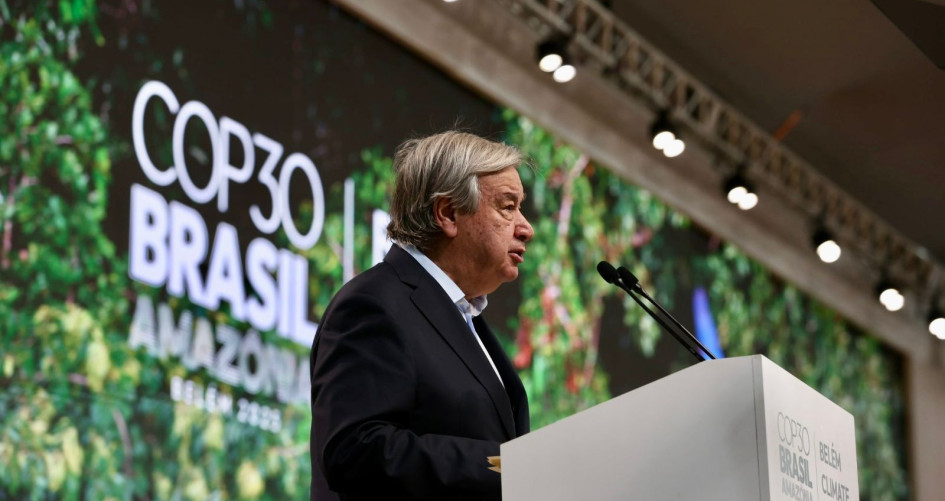
United Nations Secretary-General António Guterres delivered a stark warning at the opening of the COP30 climate summit in Belém, urging world leaders to confront what he called “the COP of truth.”
Expressing gratitude to President Luiz Inácio Lula da Silva and the Brazilian people for their warm hospitality, Guterres praised Brazil’s leadership and commitment to multilateralism “at a time when our world is at stake.”
“The hard truth is that we have failed to keep global warming below 1.5 degrees,” he said. “Science tells us that a temporary overshoot of this limit—beginning as early as the 2030s—is now inevitable.”
The UN chief warned that even a brief overshoot would have dramatic and irreversible consequences, pushing ecosystems past tipping points, exposing billions to unlivable conditions, and amplifying threats to peace and security.
“Every fraction of a degree means more hunger, displacement, and loss—especially for those least responsible,” he added. “This is moral failure—and deadly negligence.”
Emissions Keep Rising Amid Global Devastation
While acknowledging progress in countries’ updated Nationally Determined Contributions (NDCs), Guterres said they “still fall well short” of what is required, putting the world on a trajectory well above 2°C of warming.
He highlighted a disturbing reality: climate disasters are accelerating.
“Record-breaking wildfires, deadly floods, and super storms are destroying lives and economies,” he said. “Last year, emissions hit another record high, and the World Meteorological Organization confirms they are still rising.”
“Let’s be clear: the 1.5-degree limit is humanity’s red line,” Guterres declared. “We must keep it within reach.”
Yet, he emphasized, science still offers hope: if nations act with speed and scale, the overshoot can be made “as small, as short, and as safe as possible,” and temperatures can return below 1.5°C before the end of the century.
A Three-Step Plan: Small, Short, and Safe
Guterres outlined a strategy built on three urgent principles:
-
Small — by peaking global emissions immediately, accelerating the phase-out of fossil fuels, cutting methane, and protecting forests and oceans as vital carbon sinks.
-
Short — by achieving global net zero by 2050, and moving rapidly to net-negative emissions thereafter.
-
Safe — by massively boosting adaptation and resilience investment, and ensuring Early Warning Systems for All by 2027.
“The United Nations will not give up on the 1.5-degree goal,” he affirmed. “We are better equipped than ever to fight back.”
The Clean Energy Revolution Is Underway
Guterres hailed a “clean energy revolution” reshaping global economics and geopolitics.
“Solar and wind are now the cheapest and fastest-growing sources of power in history,” he said, noting that nearly all new power capacity added in 2024 came from renewables.
He underlined that $2 trillion was invested in clean energy in 2024—$800 billion more than fossil fuels—proving that clean energy “is winning on price, performance, and potential.”
“What’s still missing is political courage,” he warned.
“No More Greenwashing, No Loopholes”
The UN Secretary-General criticized ongoing fossil fuel subsidies and corporate obstructionism, accusing major companies of “making record profits from climate destruction” while spending billions to mislead the public and block progress.
“Too many leaders remain captive to these entrenched interests,” he said. “Too many countries are starved of resources to adapt or to join the clean energy transition.”
He called for COP30 to ignite a decade of acceleration and delivery, urging countries to:
-
Adopt a bold response plan to close the 1.5°C ambition gap;
-
Supercharge renewables, electrification, and energy efficiency;
-
Halt and reverse deforestation by 2030;
-
Cut methane emissions;
-
And set clear coal phase-out schedules aligned with the 1.5°C target.
“At COP28 in Dubai, countries committed to transition away from fossil fuels,” he reminded delegates. “Now is the time for action—no greenwashing, no loopholes.”
Financing Climate Justice
Guterres urged a credible path to $1.3 trillion in annual climate finance for developing countries by 2035, as agreed at COP29 in Baku, with developed nations mobilizing $300 billion annually in affordable and predictable finance.
“It’s no longer time for negotiation—it’s time for implementation, implementation, and implementation,” he said.
He called for a concrete plan to close the adaptation finance gap, ensuring the $40 billion pledge is met by year’s end and that post-2025 financing is scaled up swiftly.
Climate justice, he said, must be “at the heart of the transition,” protecting workers, empowering communities, and ensuring simplified access to the Loss and Damage Fund.
“A just transition also means Indigenous Peoples leading the way,” he added. “Their knowledge and participation light the path to a livable planet.”
“No One Can Bargain with Physics”
Concluding his speech, Guterres pledged continued UN support for developing countries through the UN Climate Promise and UNDP implementation efforts, helping them deliver and exceed their national commitments.
“The challenge is immense, but the choices are clear,” he said.
“No one can bargain with physics—but we can choose to lead, or be led to ruin. Let Belém be the turning point.”


